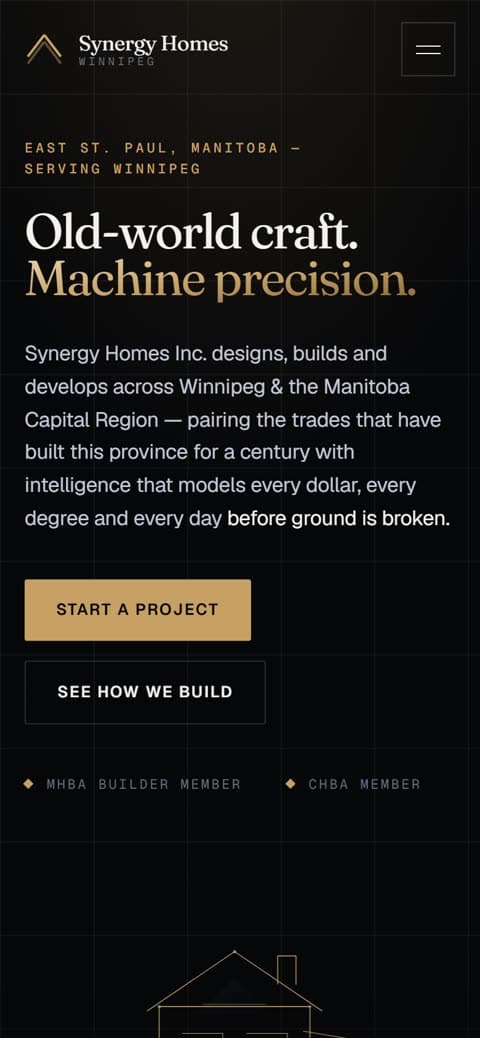
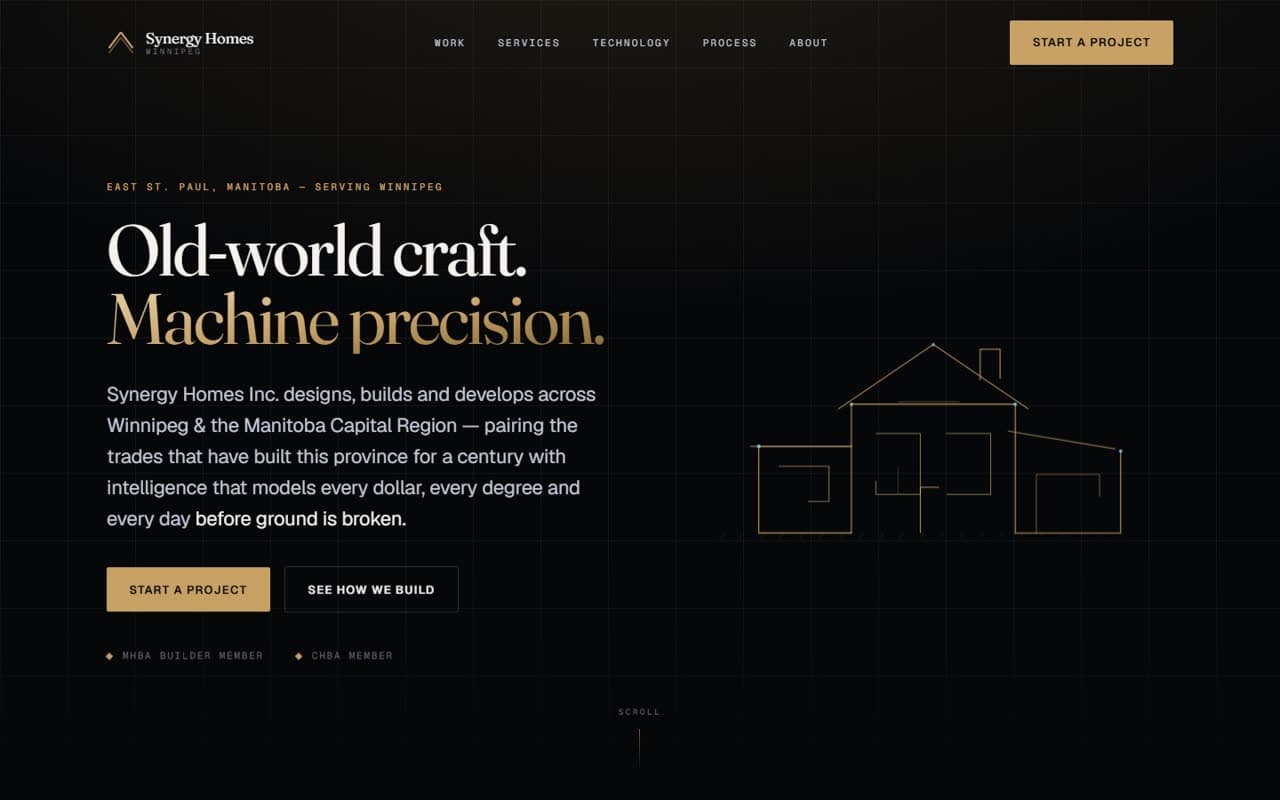
Synergy Homes
A website and inquiry intake for a Winnipeg custom home builder
Get found · Websites
Fast websites and apps on Next.js and React, the same stack we build our own products on.
Next.js and React builds on the App Router: server components, edge caching and ISR, TypeScript throughout, Core Web Vitals measured before launch.
Most companies end up running two websites without ever deciding to. There is the marketing site, usually WordPress on a theme bought years ago, and there is the product, built in a different stack behind a different login. A pricing change ships twice. The design system drifts apart. The signup flow lives on the seam between them, and that seam is where customers fall out.
Next.js closes the seam. Marketing pages, product screens, authentication, API endpoints and scheduled jobs live in one TypeScript codebase and deploy as one thing. It is the stack we build our own products on: this site, the client portal, our admin and our AI chatbot are one Next.js application.
Server components by default, client components on purpose. Most React apps ship far more JavaScript than the page needs, then hide the cost behind a spinner. We render on the server and reach for client components only where real interactivity demands it, so pages arrive fast on a mid range phone over mobile data.
Core Web Vitals measured, not assumed. LCP, INP and CLS targets are agreed before the first component, and we measure load time on real phones before launch. WCAG 2.1 AA is our accessibility target on every build, not a premium tier.
Caching designed, not inherited. Route by route we decide what is static, what revalidates on a schedule, what regenerates when content changes and what must stay dynamic. Done properly, a database backed site with a full admin serves from the edge as fast as a static one.
We also take over existing React codebases, moving them route by route rather than in one risky rewrite.
Two shapes these engagements usually take.
A site and a product on one codebase. A company running WordPress at the front and a separate React app behind the login consolidates both into one deployment, one design system, one session. Editors publish without waiting on a release; engineers ship features without touching marketing pages. Same territory as our webapps work.
A rebuild for a site that got slow. An existing React or WordPress site that collected plugins and third party scripts until it failed its Core Web Vitals, rebuilt on the App Router with URLs and redirects preserved so the SEO foundation carries over intact.
Both usually pair with cloud and DevOps work, so shipping stays boring after launch.
Next.js work is scoped to the project. A marketing rebuild and a multi tenant product on one codebase are different animals, and one rate card would mislead you on both. After a 30 minute call you get a written scope and a fixed price for it. Contact us for a quote, or browse our work and pricing first.
Share the current code if there is one, your publishing workflow and the systems the site needs to connect to. Define which parts need live data and which can be served as content.
Review real user tasks, loading behaviour and maintainability. A framework choice is a means to a reliable site, not a business outcome on its own.
A few lines on the form, or ask the assistant. A person replies within 4 business hours.
What to fix first and why, what we'd build and run, the price and the go-live date, in writing within two business days.
A website takes 2 to 6 weeks, a web app 8 to 16. Tested on real phones before launch.
Hosting, updates and the systems kept working. Monthly plans cancel any time.
You own everything.
Your code, your domain, your accounts and your data.
One contract, your currency.
You sign with Redenn Informatics Pvt. Ltd. (India) and are invoiced in your own currency. North American work is led from our Brampton, Ontario office (Redenn Informatics Inc.).
Tested on real phones.
Built mobile-first, load time measured before launch, designed to WCAG 2.1 AA.
Prices published.
Websites from $1,200, web apps from $15,000, monthly systems $149 to $249/mo plus setup from $500, and care from $49/mo.
Quoted and invoiced in your own currency by Redenn Informatics Pvt. Ltd. (India); pay by card through Razorpay or by bank transfer.
Because most companies end up running two websites without ever deciding to: a marketing site on one stack and the product behind a different login, with the design drifting apart and the signup flow falling into the seam between them. Next.js closes that seam — marketing pages, product screens, authentication, API endpoints and scheduled jobs live in one TypeScript codebase and deploy as one thing. It is also the stack we run our own business on: redenn.com, our client portal, our admin and our AI chatbot are a single Next.js application. When we recommend it, we are recommending what we chose for ourselves with our own money on the line.
It's scoped per project with one fixed price in writing before work starts. The honest anchors: a marketing site alone starts in our published website tiers on the pricing page, while an application build — logins, dashboards, payments — starts from the webapp tier, because it's a different class of work. What moves the number is the count of screens and user roles, the integrations, and whether we're migrating an existing site's content and rankings across. The proposal spells out what's in scope and what's explicitly out, so the figure you sign is the figure you pay unless you change the scope.
Speed is enforced by machinery, not promises. Core Web Vitals targets — the loading, responsiveness and stability numbers Google measures — are agreed before the first component is written, and every code change is measured against them automatically; a regression blocks the merge exactly like a failing test. Pages render on the server by default and ship JavaScript only where real interactivity demands it, so they stay fast on a mid-range phone over mobile data. Lighthouse 95+ and WCAG 2.1 AA accessibility are the floor for everything we ship, and deploys on Vercel roll back instantly if anything misbehaves.
A person replies within 4 business hours. Your written growth plan follows within two business days.
Or call +1 437 524 3001 or toll-free +1 888 905 4003, or email hello@redenn.com.