
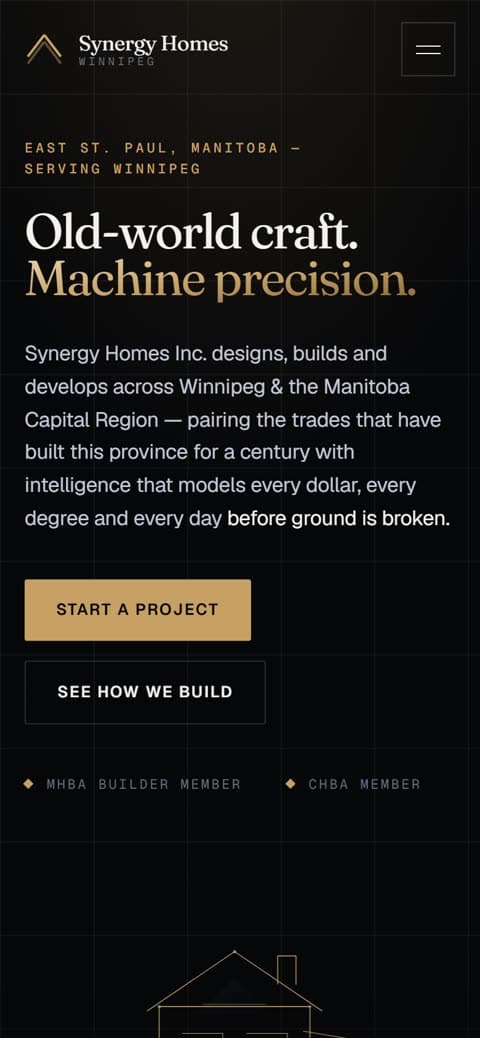
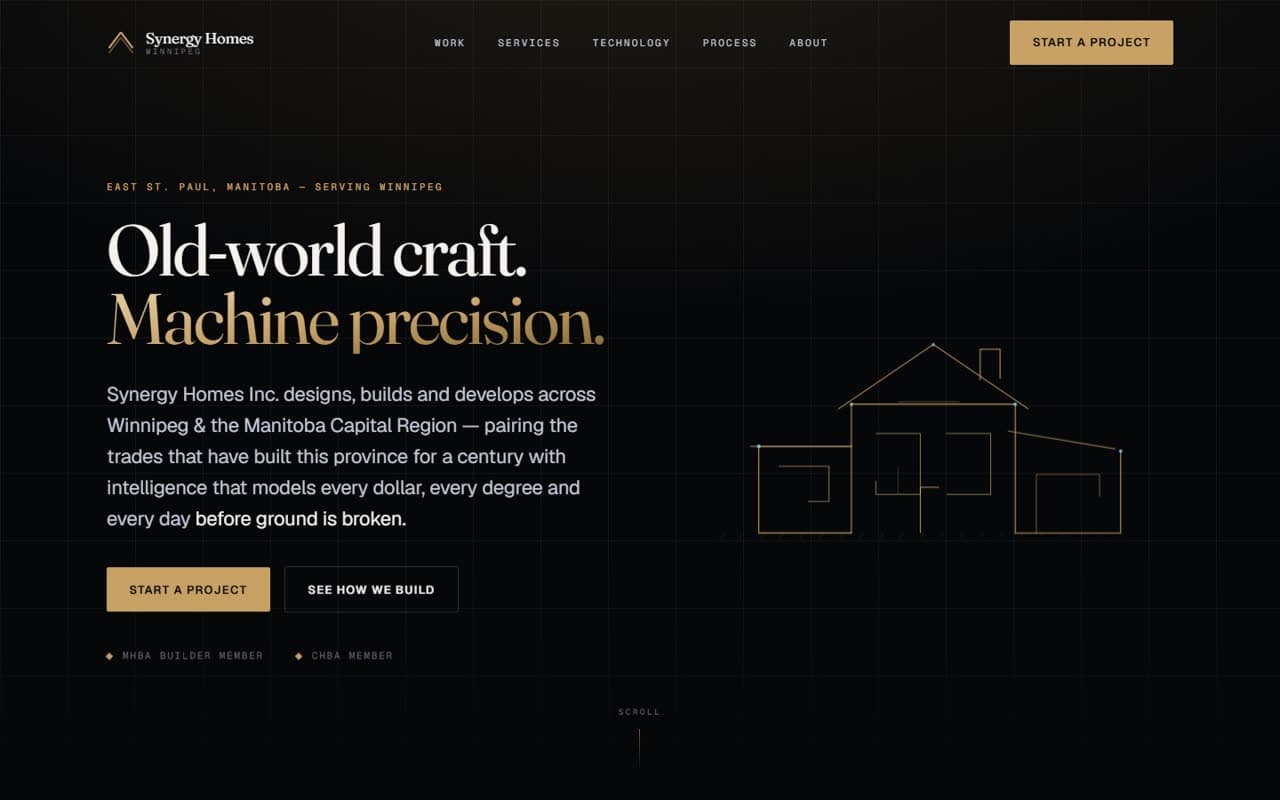
Synergy Homes
A website and inquiry intake for a Winnipeg custom home builder
Get found · Websites
Keep what works on your WordPress site, fix what slows it down, and move only when moving helps.
Slow, plugin-heavy WordPress site bringing you no enquiries? We rebuild it on Next.js and Node, keep every URL working, and hand you the code. Fixed price, agreed up front.
Most small-business WordPress sites end up the same way. A theme, then a page builder, then a slider plugin, a form plugin, a cookie plugin, an SEO plugin, a security plugin, a caching plugin to paper over the other eight. Every one of them loads code on every page. Two years later the site takes six seconds to appear on a phone, and the owner has no idea that is why the phone stopped ringing.
That is the problem we fix. Not the logo, not the copy. The reason people leave before they ever see it.
Google measures how fast your pages actually load for real visitors, and page experience is part of how it ranks you. But the ranking is not even the main cost. Someone taps your link from a Google result on a phone, waits, and taps back to try the next business on the list. You never appear in any report. You simply never hear from them.
If most of your visitors are on phones on mobile data, and for local businesses they are, this is one of the biggest things standing between your website and your next customer.
We rebuild the site as software, on Node — Next.js and React, the same stack used by companies whose entire business is their website. There is no plugin stack, because there is nothing to plug in. The pages are built once and served ready-made, so they load fast instead of being assembled while your customer waits. We measure it on a real phone before launch.
You still get to edit your own content. We wire the parts you actually change, your services, your prices, your posts, into a proper editor. What you do not get is thirty plugins with thirty auto-updates and thirty ways to break on a Tuesday.
This is the part that costs real money when a rebuild gets it wrong.
Before anything is switched over, we map every URL on your current site. Every page that has ever ranked, been linked to, or been shared keeps working, either at the same address or through a permanent redirect to its replacement. Titles, descriptions, structured data and image alt text come across with it. Your Google Business Profile, analytics and Search Console stay connected throughout.
That is how a migration should be done: nothing Google has already indexed is left pointing at a dead page.
Sometimes the honest answer is no. If your site loads fast, brings you work, and your team is happy editing it, leaving it alone is the right call and we will tell you so.
Move when the site is slow on a phone, when you are paying for plugin licences and a maintenance plan every month and still getting nothing back, when you are afraid to touch it in case it breaks, or when the thing you want to add next simply cannot be built on top of what is there.
Send us your URL and we will check what your site actually does on a phone, what is loading that should not be, and which pages are worth keeping. You get a short plain-English summary of what we would fix first. It costs nothing and there is no obligation to use us for the rebuild.
Useful inputs are administrator access, hosting details, analytics and a list of the features your team relies on. Confirm who will edit the site after launch.
Check the important URLs, form deliveries and editing tasks after the change. A new platform is useful only if it solves the original problem.
A few lines on the form, or ask the assistant. A person replies within 4 business hours.
What to fix first and why, what we'd build and run, the price and the go-live date, in writing within two business days.
A website takes 2 to 6 weeks, a web app 8 to 16. Tested on real phones before launch.
Hosting, updates and the systems kept working. Monthly plans cancel any time.
You own everything.
Your code, your domain, your accounts and your data.
One contract, your currency.
You sign with Redenn Informatics Pvt. Ltd. (India) and are invoiced in your own currency. North American work is led from our Brampton, Ontario office (Redenn Informatics Inc.).
Tested on real phones.
Built mobile-first, load time measured before launch, designed to WCAG 2.1 AA.
Prices published.
Websites from $1,200, web apps from $15,000, monthly systems $149 to $249/mo plus setup from $500, and care from $49/mo.
Quoted and invoiced in your own currency by Redenn Informatics Pvt. Ltd. (India); pay by card through Razorpay or by bank transfer.
No — and losing everything you have built is exactly what this service avoids. We rebuild your existing pages on Next.js and Node, tuned specifically for how they load on a phone, while your content and your URL structure carry over. Every existing address is mapped and redirected, so links people have shared, bookmarked or cited keep working. To your visitors it looks like your site suddenly got dramatically faster; to Google it looks like the same site, just better built. Starting from scratch is what you do when nothing is worth keeping — a slow WordPress site with good content is worth keeping.
Yes. A content editor is part of the rebuild, so you can update pages, publish posts and change wording yourself without calling a developer or touching code. Forms, bookings and payments are rebuilt and wired in as well, so the practical things your WordPress plugins were doing keep happening — just without the stack of plugins that needed constant updating underneath them. The day-to-day experience of running your site should get simpler after the move, not harder; if you could manage WordPress's admin screen, you will find this easier.
One fixed price, agreed up front before the work begins, with no surprise add-ons bolted on later. The figure depends on the size of your site: how many pages need rebuilding, how much content there is to bring across, and what your plugins currently do — forms, bookings and payment flows each need to be recreated properly on the new stack. Because every WordPress site is configured differently, we scope yours specifically rather than quoting a generic package, and the free site audit is the quickest way to find out what your particular move involves.
A person replies within 4 business hours. Your written growth plan follows within two business days.
Or call +1 437 524 3001 or toll-free +1 888 905 4003, or email hello@redenn.com.