
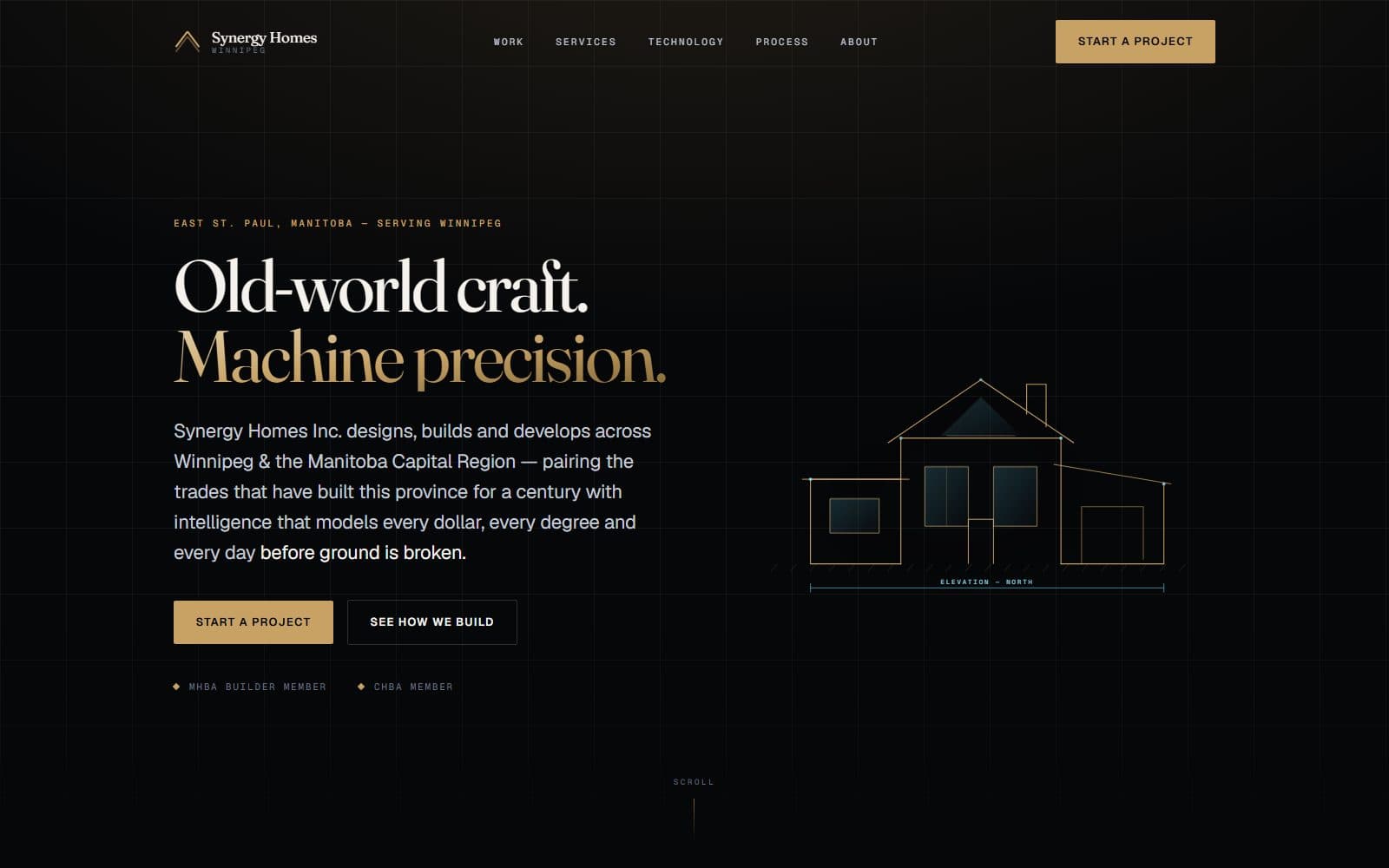
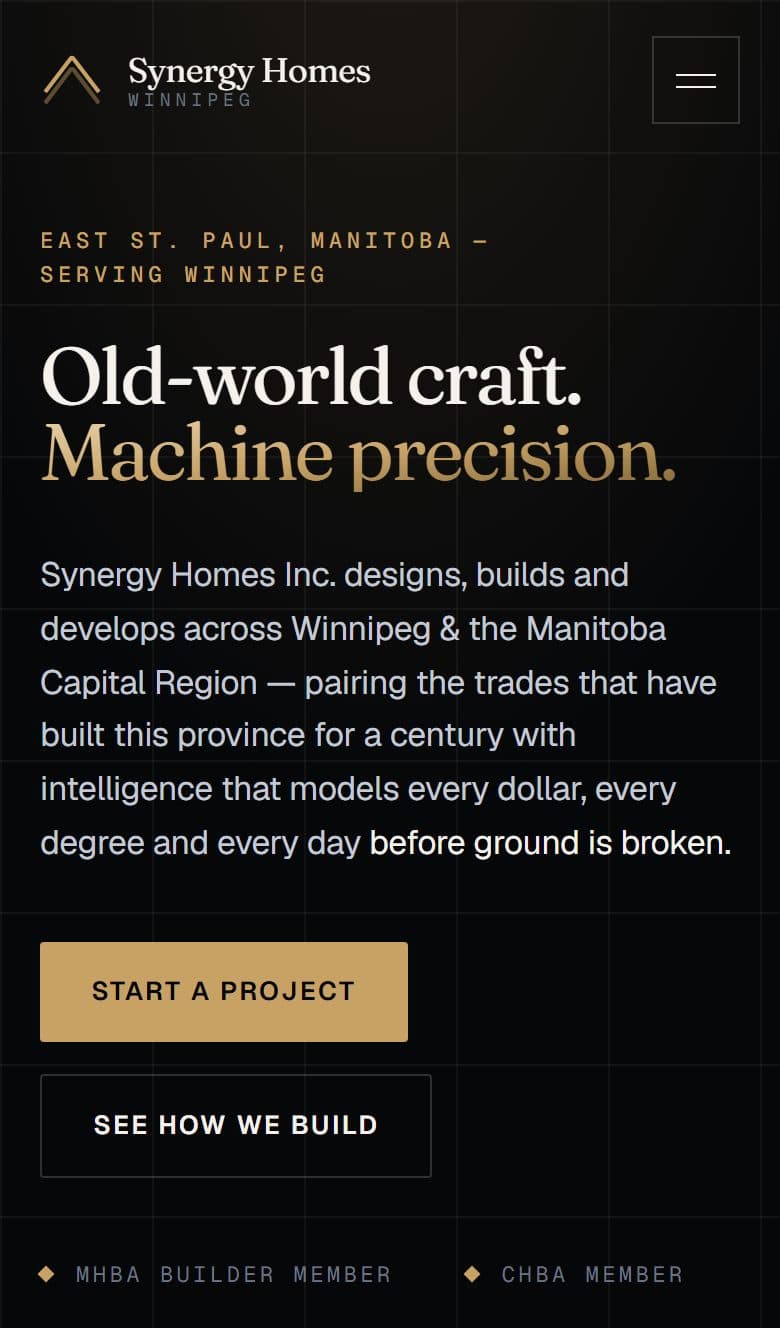
Synergy Homes Inc.
WinnipegWebsite
Inquiries get a reference number, reach the right person and are acknowledged automatically before anyone calls back.

Built to bring in businessWebsites, SEO & AI built to bring in business
Trades and contractors · Canada
Quote requests go straight to the field office, and pricing pages answer the first questions before the call.
Project notes
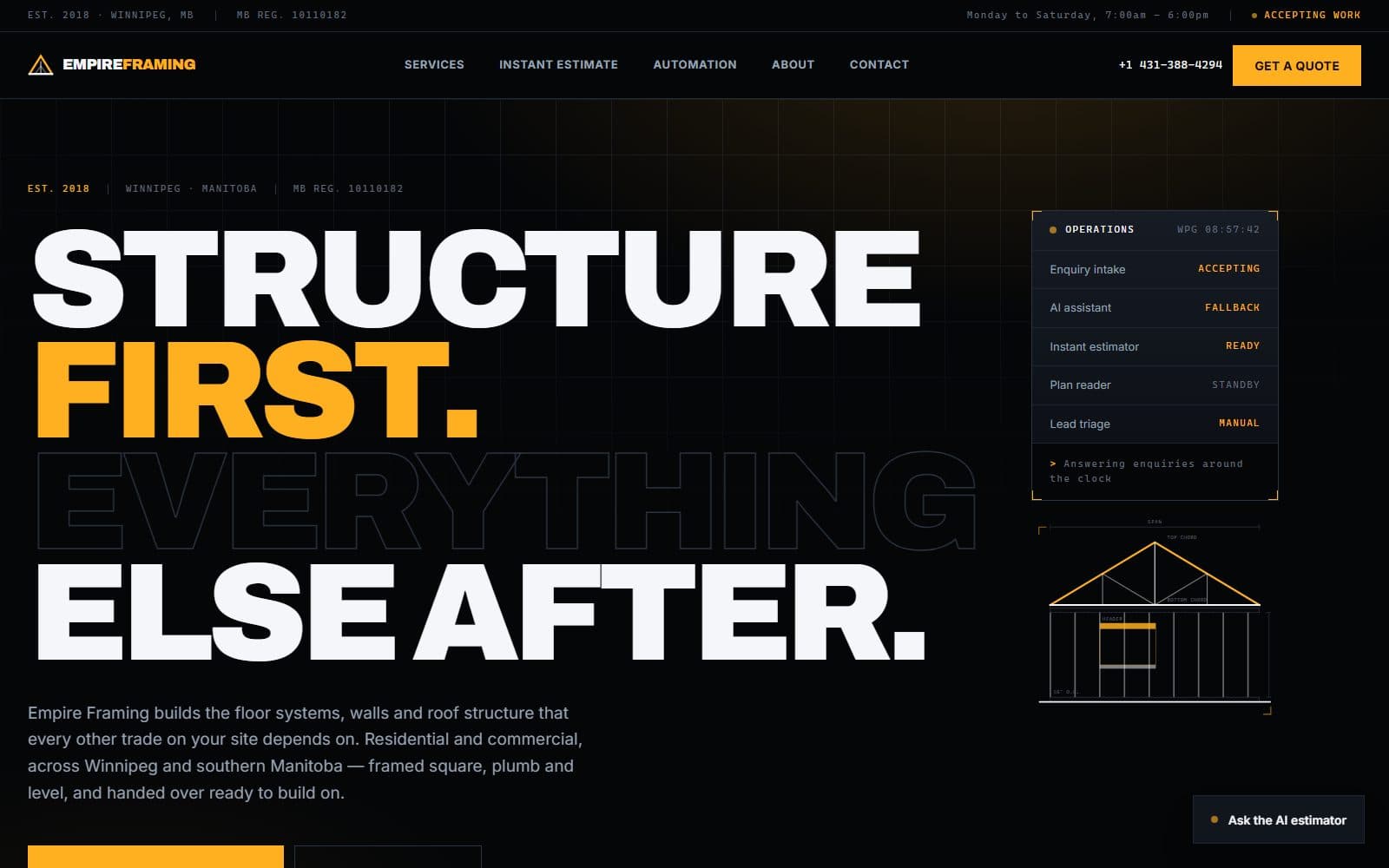
Empire Framing Inc. is a residential custom-framing contractor that has been putting up the structural skeletons of homes for more than 25 years, working across Manitoba, the Greater Toronto Area, Alberta and Ontario. Framing is a trade business, and trade businesses are won and lost on trust, clarity and a fast quote. The brief was to build a website that did all three, and that worked first on a phone, because that is where this audience lives.
A framing contractor's website has an unusual job. It is not selling an impulse purchase; it is selling a high-value, high-trust construction service to two quite different buyers. One is the individual homeowner or self-builder commissioning a custom home, an addition or a repair. The other is the developer or builder running a subdivision who needs a framing crew that can scale across many units. Those buyers want different things, do different maths, and arrive with different questions, and one website had to serve both without confusing either.
Empire's real selling points are concrete: 25 years of operation, crews of lifelong carpenters and experienced foremen, liability and WSIB coverage, and a firm commitment to honour a quoted price. The website's task was to make those points land quickly, route each visitor to the service that fits them, and get a quote request moving with as little friction as possible.
Most contractor websites are an afterthought: a logo, a stock photo of a house, a phone number. That is a missed opportunity, because the people hiring a framer increasingly research on their phone before they ever call. We approached Empire's site as a working sales tool with three jobs: explain the breadth of services credibly, be honest enough about pricing that a serious buyer feels informed, and convert that buyer into a quote request.
The breadth point matters. Empire does not do one thing. It does custom home framing, subdivision and production-home framing, steel and metal framing, site supervision, hourly work for projects that are hard to price up front, and framing repairs and project recovery. A visitor needs to see that range without drowning in it, which meant a clear service architecture rather than one long page.
The single most important flow on the site is the quote request, so the build is organised around it. Rather than burying a generic contact form, the site treats quoting as its own section with three parts: a Get a Quote entry point, a Guidelines page that tells a prospective client what information a useful quote actually needs, and an Upload path so a builder can submit drawings or project documents directly.
That structure is deliberate. A framing quote is only as good as the information behind it, and a builder who submits plans up front gets a faster, firmer number. By splitting "how to ask for a quote" from "ask for a quote", the site raises the quality of the leads that come through, not just the quantity: the field office receives quote requests it can actually act on instead of a vague "how much to frame a house?".
The quote flow also respects that framing work is seasonal and regional. A request carries enough structure — service type, location, project type — that the field office can route it to the right crew and the right province quickly, rather than treating every enquiry as a cold start.
Each service Empire offers gets its own dedicated page rather than a shared paragraph. Custom home framing, subdivision framing, steel and metal framing, hourly services and site supervision each stand alone, with the content pitched at the buyer that service is for. The custom-home pages speak to homeowners and emphasise craftsmanship, insurance and the held-price guarantee. The subdivision pages speak to developers and emphasise crew capacity, safety compliance and the ability to take a project from inception to completion. Site supervision is framed for builders who need a seasoned foreman to manage compliance and legislation on their behalf.
Splitting the services this way does two things at once. It lets each page convert the right buyer with the right message, and it gives the site a real structure for search: someone googling "steel framing contractor Manitoba" lands on a page about exactly that, not a homepage that mentions it in passing. A clear structure also makes the site easier for Empire to extend: when the business adds a service or moves into a new region, it is a new page in an established pattern, not a redesign.
Construction pricing is usually a black box, and that black box is where trust goes to die. Empire's site takes the opposite stance. The custom-home framing pages publish real starting figures — framing from a stated price per square foot for two-storey homes, a higher per-square-foot starting point for bungalows — and the site is explicit about the deposit structure: a set amount on signing plus a percentage before work begins for custom projects, with different terms for subdivision work and hourly crews.
Publishing numbers on a contractor site is a deliberate, slightly uncomfortable decision, and it is the right one. A homeowner who sees a real starting price can self-qualify before they call; the ones who do call are the ones for whom the number works. It saves Empire's estimators from quoting jobs that were never going to happen, and it signals, before a single conversation, that this is a contractor with nothing to hide about money.
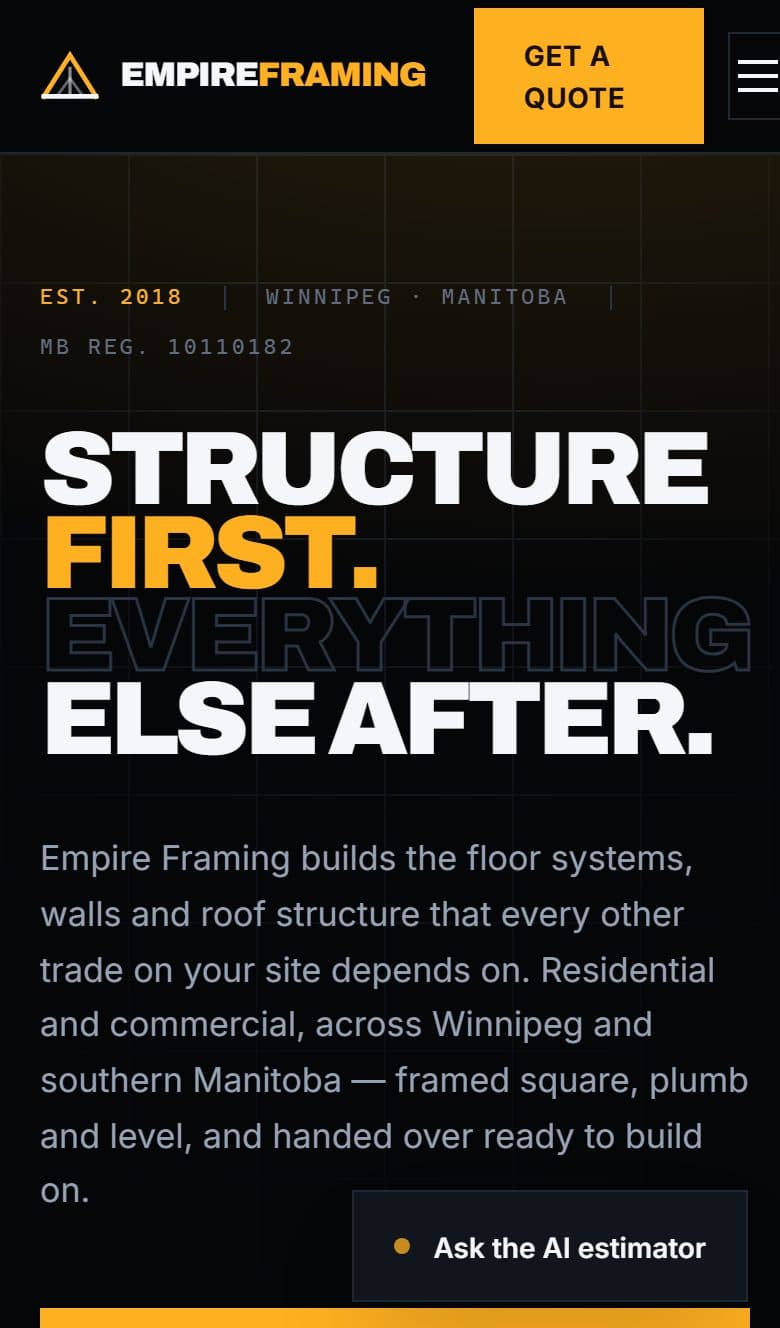
This site was designed for the phone first and the desktop second, and not as a default, but as a response to the actual audience. Builders and site supervisors check a contractor's site from a truck or a job site. Homeowners research framers in the evening on a phone on the sofa. So the layout leads with large, thumb-friendly calls to action, the navigation collapses cleanly into a mobile menu, and the quote and contact paths are never more than a tap or two away from any page. Desktop is supported fully, but it was treated as the adaptation, not the design target.
Performance was part of that decision: a site checked on mobile data from a job site has to load quickly, so the build keeps pages light rather than stacking heavy page-builder effects that look good on a designer's desktop and crawl on a mid-range phone.
Everything on the site is bent toward one outcome: a visitor believing Empire can do the job. The credibility markers — the 25-year history, the lifelong-carpenter crews, the liability and WSIB coverage, the named service areas — are placed where a sceptical buyer looks for them rather than hidden on an About page nobody reads. Photography shows real framing work rather than stock houses. The held-price guarantee is stated plainly, because in a trade where surprise costs are the standard complaint, a contractor who commits to the quote in writing has a genuine advantage worth putting at the centre of the site.
Two further sections do quiet but real work. A dedicated FAQ answers the questions that otherwise become phone calls — deposit terms, what areas Empire covers, how pricing is structured — so a serious buyer can get most of the way to a decision before reaching out, and the office fields fewer repetitive calls. And a Work With Us section turns the site into a recruitment channel: framing is a skilled trade with a constant need for carpenters and foremen, and a contractor who can hire through their own website is not dependent on word of mouth alone. A framing business needs crew as much as it needs clients, and the site was built to bring in both.
Empire Framing runs on WordPress with Elementor and PHP. The choice fits the client: WordPress and Elementor give Empire's team the ability to adjust service content, pricing and project information themselves as the business changes, without a developer on retainer for every edit. For a contractor whose pricing and service mix genuinely shift over time, an editable site is not a convenience, it is what keeps the site accurate, and an inaccurate contractor site is worse than no site at all.
Empire Framing today has a website that matches the business: broad in services, clear about who each service is for, honest about price, and built for the phone the way its customers actually browse. It turns a 25-year framing operation into something a homeowner or a developer can evaluate, trust and hire from, and it routes a real, well-formed quote request to the field office instead of a vague enquiry. For a trade business, that is the whole job of a website, and it is the job this one was built to do.
Next project
CanadaWebsite
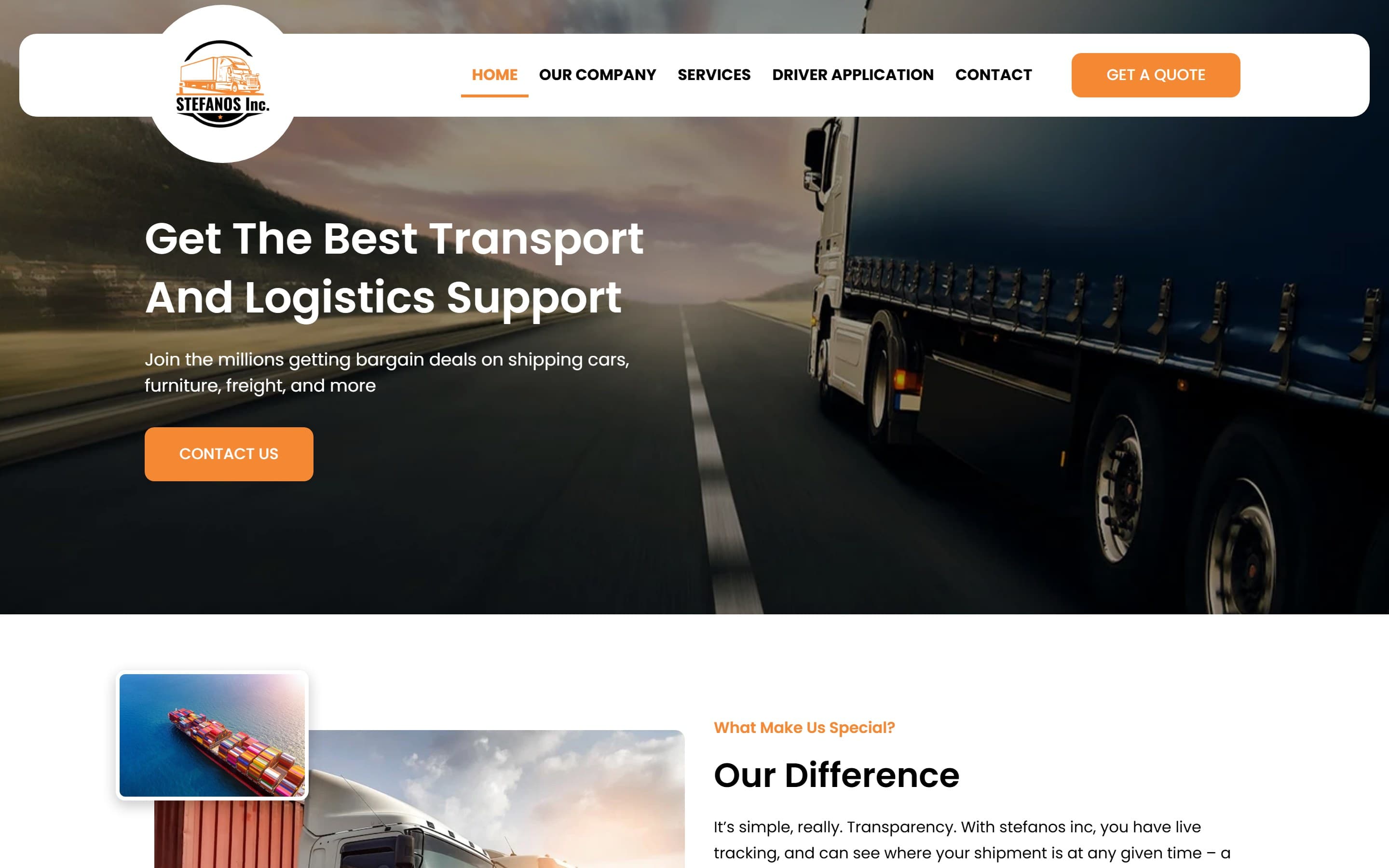
Quote requests and driver applications come in online, with live GPS tracking built in.
Open the project notes: Stefano's Inc.Live site: stefanosinc.com, opens in a new tab
WinnipegWebsite
Inquiries get a reference number, reach the right person and are acknowledged automatically before anyone calls back.
A US projectWebsite
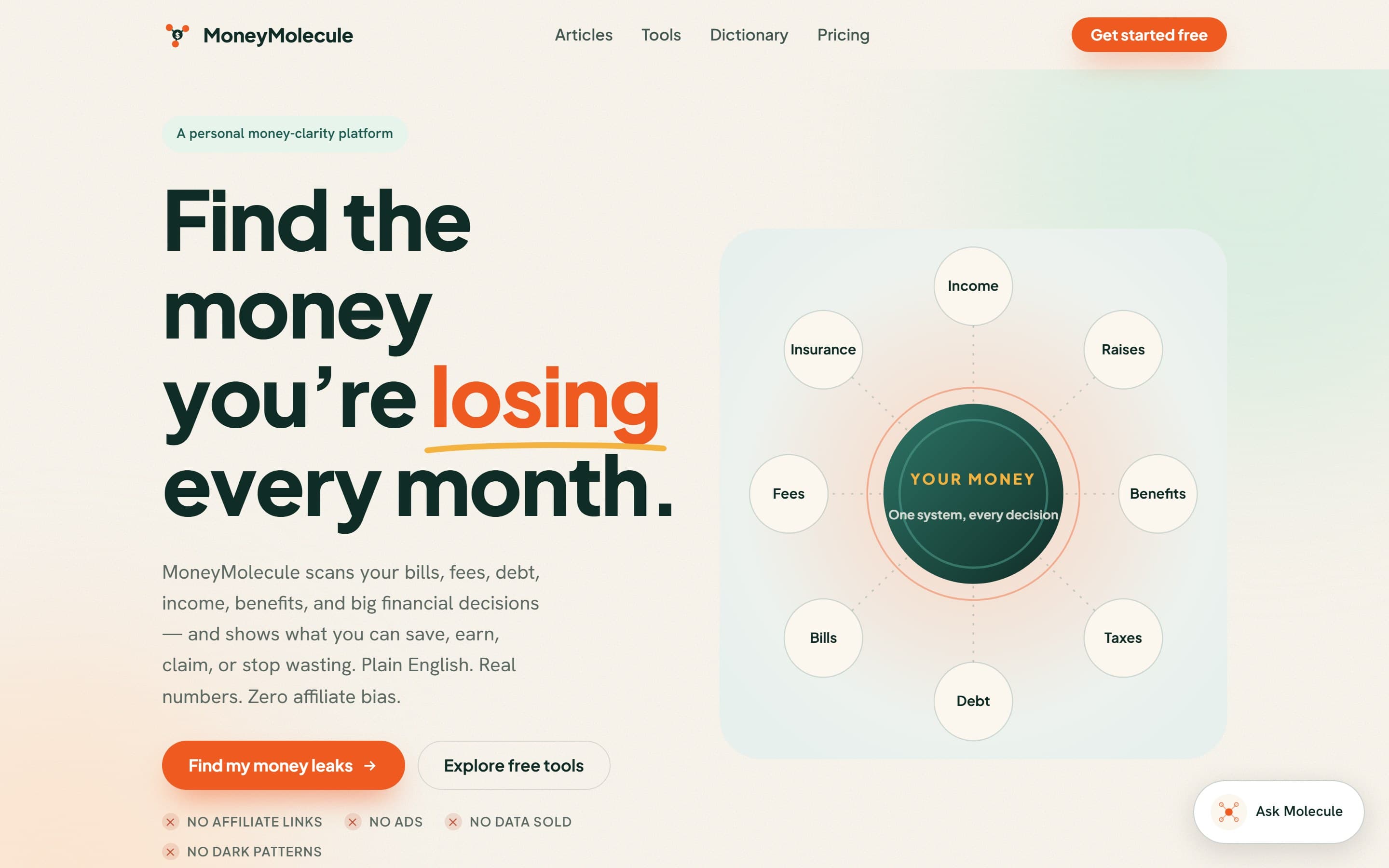
Readers find articles on saving, debt, stocks and crypto through a categorized library and site-wide search.
CanadaWebsite
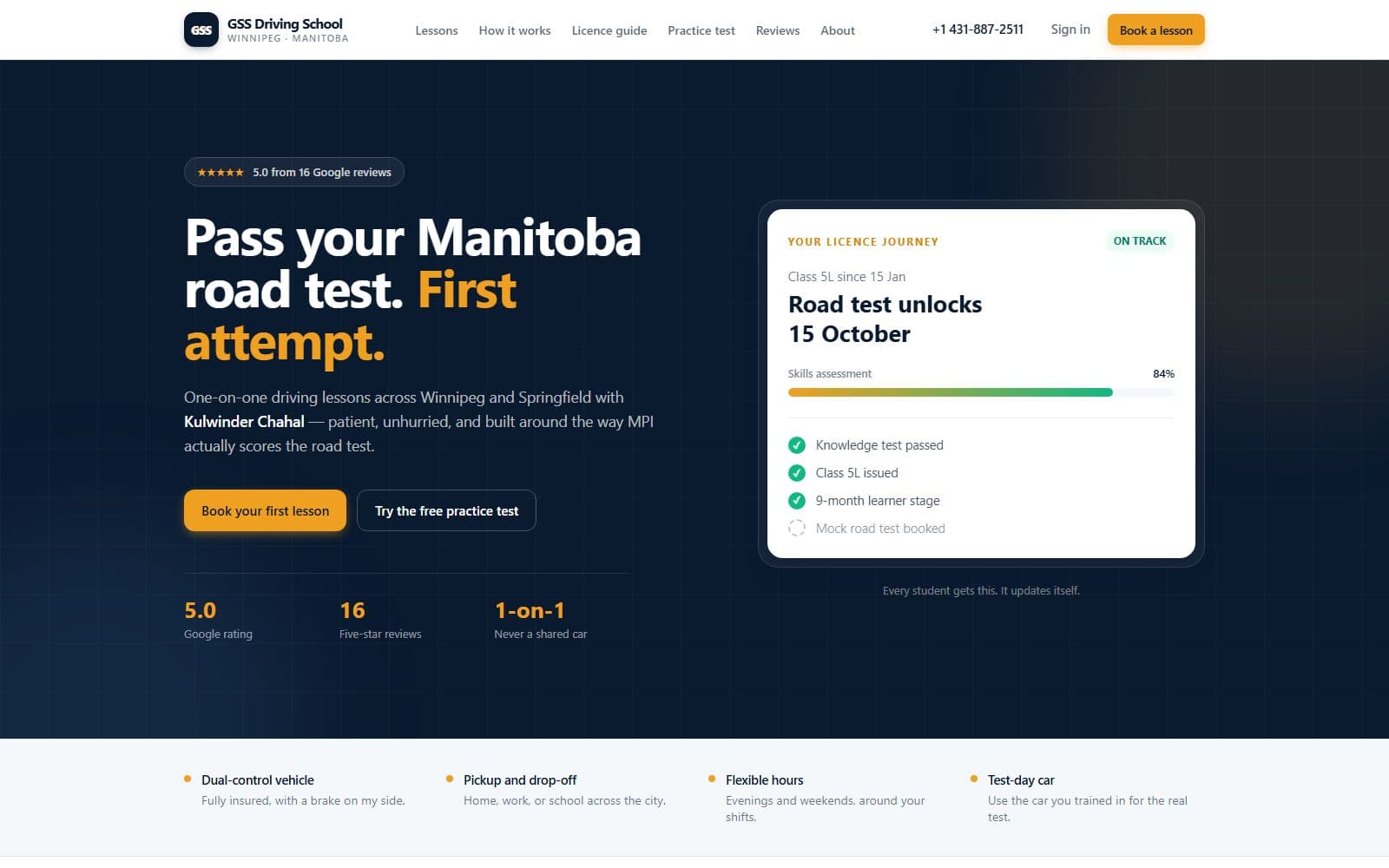
Students pick a course or road-test prep, then book a consultation from the lead form.
A person replies within 4 business hours. Your written growth plan follows within two business days.
Or call +1 888 905 4003 (toll-free), or email hello@redenn.com.
Redenn is rated 4.8 from 16 Google reviews (opens Google in a new tab)
Websites start at $1,200 and web apps at $15,000; each monthly system is $149 to $249 a month. See pricing