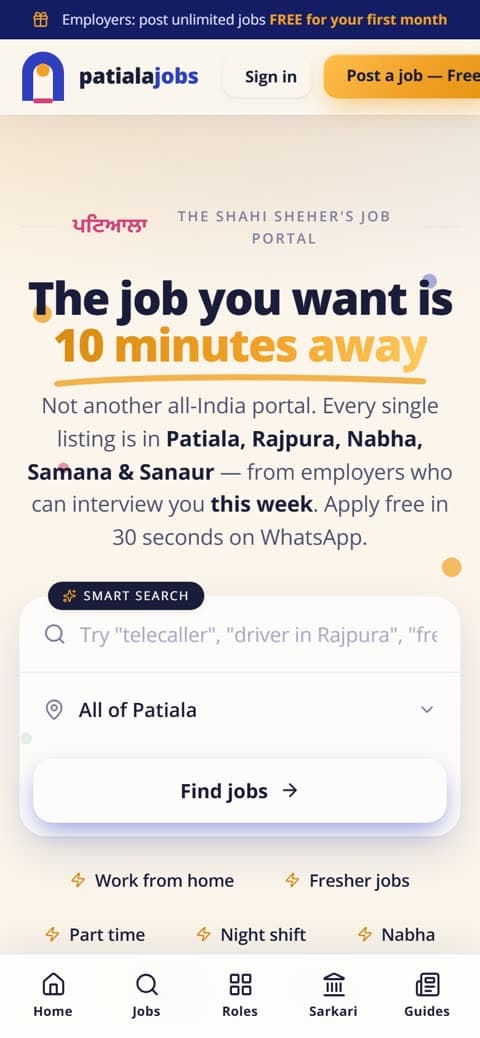


GSS Driving School
Online booking and a practice test for a Manitoba driving school
Get found · Marketing and brand
Google Ads and the landing page built by one team, with tracking that shows which clicks became inquiries.
PPC and Google Ads run by the team that also builds the landing pages, the tracking, and the CRM loop the campaign depends on.
Most PPC relationships end in the same argument. The agency shows a dashboard where everything is green — impressions up, cost per click down, click-through rate climbing — and the owner says the phone isn't ringing. Both are telling the truth. The clicks arrived, and landed on a page never built to turn a stranger into an inquiry.
That gap is structural. When the people running the ads cannot touch the landing page, traffic goes to whatever page exists, usually a homepage written for browsing rather than deciding. The one thing deciding whether the money comes back waits on a developer booked until next month. We are a build shop that runs ads, so the page is inside our scope: same team, same repo.
We build the landing page, then keep rebuilding it. Campaigns get purpose-built pages, not a homepage with a tracking parameter on the end, and they ship on our usual standards: built to WCAG 2.1 AA, and fast on a real phone — we measure it before launch. When the data says the form is too long or the offer is buried, we change it.
Negative keywords are the job, not the afterthought. Broad match with an untended negative list is how budgets evaporate into searches for free versions, jobs and homework help. We mine the search terms report on a fixed cadence and keep one shared negative list, so a lesson learned in one campaign applies across the account.
Tracking measures money, not form fills. A form fill is a proxy, and optimising toward one buys cheap leads nobody wants. We wire tracking properly, then close the loop: qualified and won outcomes import back into Google Ads from your CRM, so bidding learns which clicks became customers.
Two shapes most engagements take:
A local service business on Search. A clinic, trades company or professional practice competing for high-intent local searches. Campaigns structured by service, an aggressive negative list, call tracking, and a dedicated landing page per service instead of one catch-all. Leads reach the CRM with campaign and keyword attached; won deals flow back to Google as conversions.
An ecommerce catalogue on Shopping and Performance Max. The product feed gets cleaned and structured before a dollar is spent, because feed quality decides Shopping performance more than bidding does. Best sellers, long tail and clearance are separated so they stop bidding against each other, with remarketing on cart abandoners. Pairs naturally with an ecommerce build.
Paid search captures demand that already exists; SEO compounds it and social creates it.
PPC management is scoped per project. Effort depends on how many campaigns you run, how much landing page work the account needs, and how deep the tracking integration goes — a flat percentage of spend would overcharge some clients and underserve others. After a short call you get a fixed scope in writing. Media budget is separate, paid directly to the platforms. Contact us for a quote.
Share account access, approved offers, target locations and the value of a suitable customer. Existing conversion data should be checked before it is used to guide spending.
Evaluate qualified leads or purchases against spend. A high click-through rate does not compensate for irrelevant inquiries or an unclear landing page.
A few lines on the form, or ask the assistant. A person replies within 4 business hours.
What to fix first and why, what we'd build and run, the price and the go-live date, in writing within two business days.
A website takes 2 to 6 weeks, a web app 8 to 16. Tested on real phones before launch.
Hosting, updates and the systems kept working. Monthly plans cancel any time.
You own everything.
Your code, your domain, your accounts and your data.
One contract, your currency.
You sign with Redenn Informatics Pvt. Ltd. (India) and are invoiced in your own currency. North American work is led from our Brampton, Ontario office (Redenn Informatics Inc.).
Tested on real phones.
Built mobile-first, load time measured before launch, designed to WCAG 2.1 AA.
Prices published.
Websites from $1,200, web apps from $15,000, monthly systems $149 to $249/mo plus setup from $500, and care from $49/mo.
Quoted and invoiced in your own currency by Redenn Informatics Pvt. Ltd. (India); pay by card through Razorpay or by bank transfer.
That argument ends most PPC relationships, and both sides are usually telling the truth. The clicks really arrived — and they landed on a page never built to turn a stranger into an inquiry, typically a homepage written for browsing rather than deciding. The gap is structural: most PPC agencies employ media buyers, not designers and engineers, so the one thing that decides whether the money comes back — the landing page — is out of their hands, waiting on a developer booked until next month. We're a build shop that runs ads: the page is inside our scope, same team, same repository, same week.
Search, Shopping, Performance Max and remarketing campaigns — plus the parts most agencies can't touch. Campaigns get purpose-built landing pages, not a homepage with a tracking code stuck on the end, shipped to the same standards as everything we build: Lighthouse 95+, accessible, fast on a mid-range phone. Conversion tracking is wired properly, including offline import — so when a click becomes a phone call and then a signed customer in your CRM, the campaign learns it. And negative keywords are treated as the job, not the afterthought, because broad match with an untended negative list is how budgets evaporate into searches for free versions and jobs.
Two separate numbers, kept deliberately separate. Your media budget is paid by you directly to Google from an ad account in your name — it never blurs into our fee, and you can see every dollar of spend at the platform level. Our management fee is scoped per project and fixed in writing, driven by how many campaigns and landing pages the engagement needs and how much tracking has to be built or repaired first. What a sensible media budget looks like depends on your market and what a customer is worth to you — bring that number to the scoping call, because it shapes the whole strategy.
A person replies within 4 business hours. Your written growth plan follows within two business days.
Or call +1 437 524 3001 or toll-free +1 888 905 4003, or email hello@redenn.com.