
Strategy
Canadian Realtors: Why Your $200/Month Website Has Never Brought You a Single Lead
Every Canadian realtor has roughly the same website — and that's exactly why none of them work. The honest audit, the features that actually convert, and the math on dropping the subscription trap.
April 29, 2026 · 14 min read
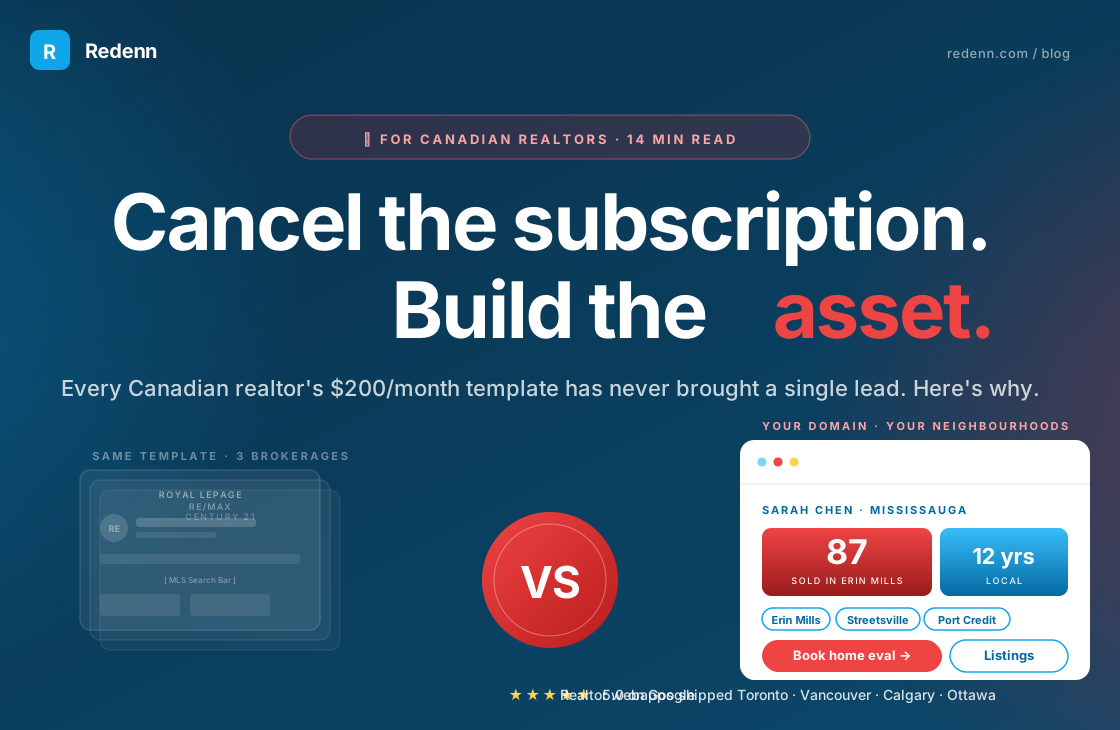
Open your website right now in a private browser tab. Scroll it. Pretend you're a stranger from Mississauga who just searched for "buying a house in Erin Mills." Be honest with yourself: would you trust this person with the biggest financial decision of your life, based on what's on this page?
Most Canadian realtors, when they do this exercise, go quiet for about thirty seconds. The site looks like a thousand other realtor sites. A stock-photo banner of a generic suburban street. An IDX search bar that returns the same MLS data every other realtor in the country shows. A headshot, a phone number, three "Featured Listings" that are just the brokerage's hottest inventory. The agent's actual personality — the thing that makes a client choose them over the agent down the street — is nowhere on the page.
And every month, $99 to $300 leaves the realtor's account to keep this site online.
This article is a hard look at why almost every Canadian realtor's website is failing, what a properly-built webapp looks like instead, and the math on switching. We don't sugar-coat any of it, because realtors are sophisticated buyers — you negotiate prices for a living, you can spot a soft sell — and we're not going to pretend the industry standard is fine when it isn't.
The audit nobody runs on themselves
Before going further, do this audit honestly. We've watched hundreds of realtors do it; the answers are remarkably consistent.
The pattern in the answers, when realtors are being honest: tiny number, tiny effort, painful cost, no, nothing. Five clean signals that the website is a line item, not an asset.
Why every Canadian realtor has the same website
This isn't a coincidence. The Canadian realtor website market is dominated by maybe seven or eight platforms — myRealPage, RealtyNinja, AgentLocator, Placester, the white-labelled brokerage CMSes, plus a handful of regional vendors. Each of them sells templates. The templates are slight variations on the same architecture: hero banner, search bar, featured listings, "Meet your agent," contact form.
The economics force this outcome. A vendor charging $99 a month per agent has to support thousands of agents on a small team, which means heavy templating. There is no business model in which the vendor builds a custom site for $99 a month. So they don't. They sell you a slot in a template, ship it in 48 hours, and bill you forever.
The result is what marketers call category sameness: when every product in a category looks identical, the customer can't differentiate, and price (or in our case, brokerage brand) becomes the only signal. Real estate is the most extreme example of this in Canadian small business — drive down a list of 50 realtor sites in any GTA neighbourhood and they're visually interchangeable. The agents themselves are wildly different people; their websites are not allowed to show it.
3 BROKERAGES · SAME TEMPLATE
Visually invisible
Sarah · Royal LePage
David · Re/Max
Priya · Century 21
+ all 50 other realtors in your cityThe customer can't tell them apart
YOUR REDENN WEBAPP
Built around your neighbourhoods
SARAH CHEN · MISSISSAUGA
"87 homes sold in Erin Mills. Yours could be next."
Differentiated. Memorable.Built to compound
Where Canadian realtor leads actually come from
Now for the chart that explains why those template sites underperform. Industry surveys (CREA, NAR-Canada, broker association data) consistently put the breakdown of where realtor leads originate close to this:
Look closely at this chart, because it contains the entire strategic argument:
- 63% of business comes from referrals and repeat clients. These people don't find you online — but they Google your name to verify you before reaching out. If your website looks like every other realtor's, you've passed the smell test but added nothing. If it's exceptional, you've just upgraded a maybe-call into a definite-call.
- 22% finds you through Google. Half of that is people searching your name (because they were referred or saw your sign). The other half — 9% — is people searching neighbourhoods, market trends, "first-time buyer Toronto," "selling condo Burlington." This is the slice your website can grow, and it's the slice template sites are mathematically incapable of capturing. You can't out-rank REALTOR.ca on listings, but you absolutely can out-rank everyone on neighbourhood content and buyer guides.
- 2% comes from the template site itself. This is the slice that justifies $200 a month, in most realtors' minds. It doesn't.
The strategic conclusion is simple. Your website's job isn't to generate leads from cold strangers — that's almost mathematically impossible against REALTOR.ca and the major portals. Its job is twofold: (1) close the referral that's already half-decided, and (2) capture the long-tail Google searches your competitors aren't writing for. Template sites do neither. A custom webapp does both.
What a realtor webapp can actually do
Now to the features. This is the part where realtors usually hear their existing vendor say "yes, our platform can do that" — for ten add-ons at fifteen dollars apiece. A custom webapp ships with all of these built in, no add-ons, no upsells.
📍 Hyperlocal neighbourhood pages
One ranked page per neighbourhood you serve. Schools, transit, parks, average sale price, your sold listings there. The single highest-ROI SEO move in real estate.
📊 Auto-generated market reports
Monthly market snapshots per neighbourhood, updated automatically from your MLS feed. Sellers love them. Google rewards fresh content.
🏠 Sold-listings showcase
Not just your active listings — your sold portfolio with real numbers (where allowed by your provincial regulator). Your single best credibility asset.
📖 Buyer & seller guide library
"First-time buyer in Ontario," "Selling a condo in Vancouver," "Land transfer tax in Alberta." Long-tail Google queries that template sites have zero of.
🧮 Province-specific calculators
Mortgage affordability, land transfer tax (different in ON, BC, QC, MB), closing costs, CMHC insurance. Reasons to bookmark your site.
🎬 Video tours & reels embedded
Property walkthroughs, neighbourhood vlogs, market commentary. Your YouTube and Instagram, organised on your domain instead of theirs.
⭐ Real client testimonials, owned by you
Not Zillow reviews you can't take with you when you change brokerages. Stories on your domain, displayed how you choose.
📅 Direct booking for evaluations & tours
Calendar integration. Sellers book a free home evaluation. Buyers book a property viewing. Goes straight to your calendar, not a third-party CRM.
🔍 Proper IDX integration
MLS search, but built into your site instead of in an iframe ghetto on a subdomain. Same listings, infinitely better experience.
🔔 Saved-search alerts
Buyers save criteria, get an email the moment a matching listing hits MLS. Builds a lead list automatically without paid ads.
📱 Mobile-first design
Most of your clients are looking at your site on a phone. Most template sites still treat mobile as an afterthought. Yours won't.
⚡ Sub-second load speed
Template sites load in 5–8 seconds. Yours loads in under one. Google ranks you higher and visitors don't bounce. Both compound.
🌐 Bilingual where it matters
Quebec, Ottawa, Moncton, parts of Toronto — bilingual content doubles your addressable market without doubling your work.
🔒 PIPEDA-compliant lead handling
Lead consent, opt-out logging, encrypted storage. The compliance most template sites quietly skirt — done right from day one.
"Your subscription website's job is to keep you paying the subscription. Your own webapp's job is to grow your business. These are not the same job."
The dozen comparisons that decide it
| Category | Subscription template site | Custom Redenn webapp |
|---|---|---|
| 1Cost model | $99–$300/month forever. Average realtor pays $1,200–$3,600/year, in perpetuity. | One-time build, low fixed hosting (~$80/mo). Predictable for a decade. |
| 2Differentiation | Looks like every other realtor's site in your city. Visually invisible. | Built around your brand, your neighbourhoods, your story. Memorable on first visit. |
| 3SEO potential | Same template = same generic content as 10,000 other realtors. Ranks for nothing. | Hyperlocal pages, original guides, fresh market reports. Built to rank. |
| 4Page speed | 5–8 seconds on mobile. Half your visitors leave before the page loads. | Sub-second. Visitors stay, Google ranks you higher, the cycle compounds. |
| 5Lead capture | A contact form that emails you. Maybe a basic newsletter signup add-on. | Multiple lead magnets, automated nurture sequences, saved-search alerts, evaluation bookings. |
| 6Content management | Limited templates. Posting a market update means filling their fixed form. | Self-serve CMS. Post articles, market reports, video — in your voice, your formatting. |
| 7Brokerage independence | If your site is brokerage-provided, changing brokerages means losing it. | Yours forever. Your domain, your content, your reviews — across any brokerage you join. |
| 8Reviews & testimonials | Locked into vendor's review system. Leave the platform, lose the proof. | Owned on your domain. Years of reviews stay with you, no matter what changes. |
| 9IDX integration | Iframe on a subdomain that breaks your design. Often a separate URL. | MLS search built natively into your site. Same listings, way better UX. |
| 10Compliance | Generic, US-influenced templates. PIPEDA, RECO, CREA advertising rules left to you. | Built to PIPEDA, your provincial regulator's advertising rules, and CREA marketing standards. |
| 11Add-on features | "Premium" tier $50 more, lead-gen $40 more, CRM $30 more. The bill creeps up every year. | Everything you need is built in. New feature requests ship as updates, not subscription tiers. |
| 12Long-term ownership | Stop paying = site disappears. Domain authority, content, reviews — all evaporate. | Your codebase, your database, your domain. An asset on your business's balance sheet. |
The 10-year cost picture
Same chart we'd run for any subscription business decision. The numbers below assume an average Canadian realtor's all-in subscription cost of $200/month (site + IDX + lead-gen add-ons + CRM tier), with a typical 5% annual price rise. The custom webapp side: a one-time $9,500 build, $80/month hosting and updates.
For a team of two or three agents pooling on shared software, the gap widens further. The crossover happens earlier (typically around year four), and the long-tail savings approach $25,000 across a decade. Either way, the same conclusion: the subscription model wins on month one, loses on year three, and is hemorrhaging money by year ten.
What this looks like in practice
Three anonymised examples from Canadian realtor clients who switched in the last eighteen months. All three were on subscription template sites averaging $180–$240 per month before the switch.
🏙 Toronto — East York specialist
From a generic template to ranking #1 for "East York realtor" in 5 months
The agent had been on a popular subscription platform for four years, paying $189/month, with one inquiry from the site over the entire period. We rebuilt as a webapp with eight neighbourhood-specific landing pages (Leaside, Riverdale, Danforth Village, the Pocket, etc.), each with original market commentary refreshed monthly. Within five months, the site ranked first or second on Google for every one of those neighbourhood searches plus the agent's name, and was generating 8–14 inbound inquiries per month — most of which converted to listings or buyer representation.
⛰ Calgary — Inner-city luxury team
Replaced $480/month team subscription with a webapp, ROI in 14 months
A three-agent team in inner-city Calgary was paying $480/month combined for a "team plan" on a platform that included CRM, IDX, and templated agent profiles. The interface was dated, the lead capture barely worked, and the agents had stopped pointing clients to the site. We built a custom team webapp with proper agent pages, a unified team brand, automated market reports for Mount Royal, Elbow Park, and Mission, and a working buyer-portal for saved searches. Build cost: $14,200. They cancelled the SaaS the week we shipped. Payback complete in 14 months; over five years, ~$13,000 retained net of build cost.
🌊 Vancouver — West Side condo specialist
Bilingual site (English + Mandarin) opened a market the template couldn't
The agent's biggest competitive edge was being fluent in Mandarin in a neighbourhood where roughly a third of high-end condo buyers preferred Mandarin-language service. Her template platform offered no realistic way to publish bilingual content. We built a webapp with full English/Mandarin parity — every neighbourhood guide, every market report, every property listing. Within a year, half her inbound inquiries were coming through the Mandarin side of the site, including buyers who specifically said they chose her because her materials were available in their language.
Why Redenn — for Canadian realtors
Built for Canadian realtors, not bent into realtor-shape from a US template kit.
Most agencies that touch realtor sites are either generic web shops who don't understand real estate, or real-estate-specific vendors selling a templated subscription product they can't customise. We're neither. We're a Canadian-led design studio with a deep engineering team, building one custom webapp at a time — most of which happen to be for real estate, medical, and small-business clients across Canada and the US.
We understand the Canadian context that generic vendors miss: PIPEDA-compliant lead handling, RECO and provincial advertising rules, CREA's marketing standards, and the regional differences between TRREB, REBGV, CREB, and the smaller boards. We know that you can't put just any sold-listing data on a public site, that "for sale" and "just listed" have specific advertising rules in your province, and that your branding has to follow your brokerage's marketing standards. None of that surprises us mid-build.
And — same studio model that powers every Redenn site: design and engineering done by the same team. Our design lead works out of Brampton, Ontario, and our engineers ship from Patiala, India. One studio, two offices, fair Canadian rates without the New York surcharge. The thing other agencies bolt on as "premium tier" is the thing we won't ship without.
Every realtor webapp we deliver ships with the SEO foundation pre-built — proper schema markup (RealEstateAgent, Place, Residence), neighbourhood-page architecture optimised for local search, page-speed budgets that get you ranked instead of penalised, and a baseline of three to five neighbourhood guides written and ready to publish on day one. SEO isn't an upsell. It's the floor.
🇨🇦
North America office Brampton, Ontario · Design, client lead, PIPEDA & provincial compliance🇮🇳
Asia Pacific office Patiala, Punjab · Engineering, IDX integration & SEOThe decision, at a glance
The Canadian realtors who'll dominate their neighbourhoods in 2030 aren't going to do it through bigger ad budgets or cleverer flyers. They're going to do it because they planted SEO assets — neighbourhood pages, market reports, buyer guides — five years earlier and let Google compound the results. While their competitors were still paying $200 a month for an invisible template that brought zero leads, they were building a real estate brand on the open internet, on a domain they own.
The cost is roughly the same on year one. The cost diverges enormously by year five. The strategic position diverges even more. A custom webapp by year five is an asset on your business's balance sheet, generating leads you didn't pay for, ranking for searches your competitors don't even know exist. A subscription template by year five is the same template, costing ten per cent more per month than it did at signup, generating the same 0–2 leads a year it always did.
Cancel the subscription. Build the asset. Own the result.
Want this done properly on your site?
Tell us the goal in a sentence. A senior person replies within 4 business hours.
Keep reading
September 9, 2026
Why Most Small-Business Websites Lose Customers Before the First Click
Most small-business websites fail quietly. Here's why customers leave and what Redenn Informatics does differently to fix it.
September 8, 2026
Choosing a Web Development Partner: The Questions That Actually Matter
Before hiring a web developer, ask about ownership, process, and what happens after launch. A practical guide from Redenn Informatics.
September 7, 2026
Accessibility as a Business Advantage: Compliance Isn't the Point, Revenue Is
Accessibility isn't a legal checkbox. It's a growth lever most competitors ignore. Here's how Redenn Informatics builds for it properly.
Got a project in mind?
We will send back a fixed price and a ship date — no discovery deck, no hourly rates, within two business days.
We reply within 4 business hours.