
For Doctors
Doctors: Why Your Online Presence Shouldn't Live on Someone Else's Platform
You spent ten years earning your title. A directory site reduced it to four lines and a star rating. Why every doctor needs to own their digital presence.
April 22, 2026 · 14 min read
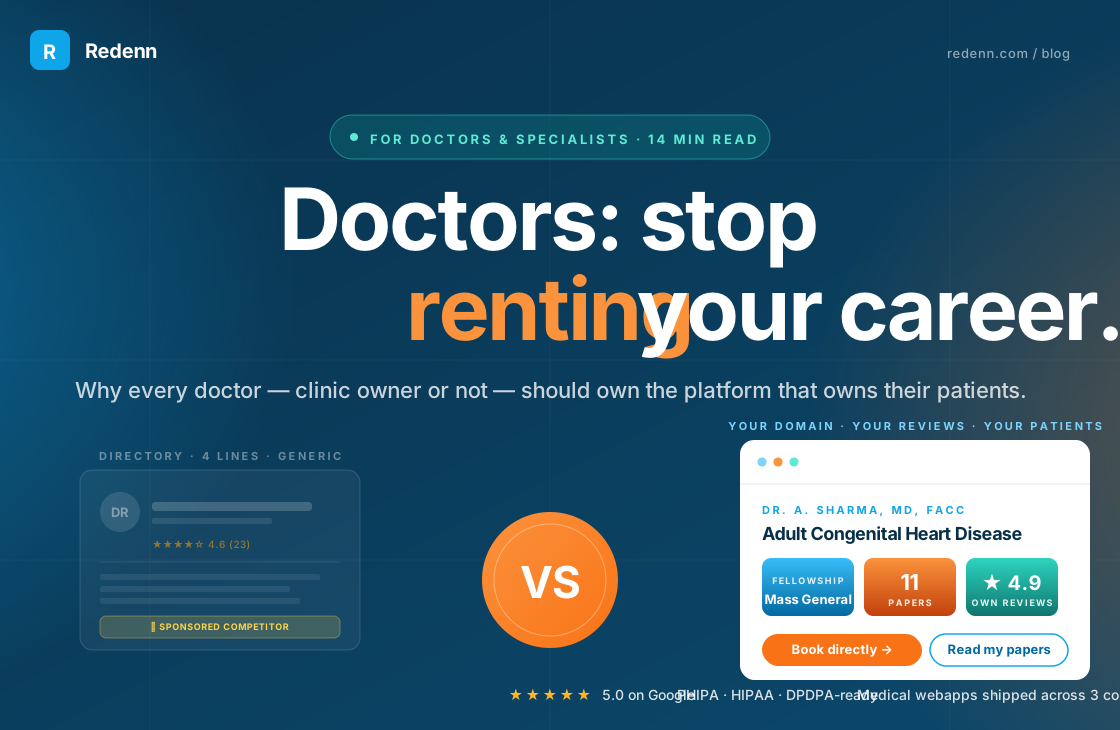
Pull up your name on Practo, RateMDs, ZocDoc, or Healthgrades. What does the patient see? A two-line bio. A stock-photo headshot the platform's onboarding form pulled from somewhere. A specialty dropdown. A star rating averaged from a handful of reviews you didn't ask for. And — right next to your card — three of your competitors bidding for the same patient's attention.
That is your professional presence on the modern internet. The career you built across medical school, residency, and a decade of clinical practice — flattened into a marketplace tile, optimised for the platform's revenue and not for yours.
This article is for two kinds of doctors.
If you don't have your own website yet because you "haven't opened a clinic" or "the listing sites do enough" — the first half is for you. We'll explain why owning your digital presence early is one of the highest-leverage decisions in a medical career, and why it pays back compoundly when you eventually do open your own practice.
If you already run a clinic and you're paying $99 to $300 a month for SaaS clinic-management software — the second half is for you. We'll walk through why a custom webapp typically beats a subscription tool on a five-to-ten year horizon, and when it doesn't.
Both halves end with the same conclusion: the doctors who own their digital infrastructure are quietly compounding an advantage that the doctors renting it can never catch up to.
Part one: why every doctor needs a personal webapp — even before they open a clinic
What a directory listing actually shows
Listing platforms exist for one reason: aggregating supply so they can sell access to demand. They package thousands of doctors into a searchable database, rank them by criteria they control, and surface paid placements above organic ones. The platform is the brand. You are inventory.
The economic model isn't sinister — it's just not aligned with you. A listing site wants the patient on its platform, not on yours. Every architectural choice flows from that:
- Your bio is short. Long enough to fill a card, not long enough to differentiate. Your fellowship at Mass General gets four words. Your published research gets none.
- Your specialties are a checkbox list. "Cardiologist" is a checkbox. "Cardiologist who specialises in adult congenital heart disease and has authored 11 peer-reviewed papers on the topic" is not a checkbox.
- Reviews live on their platform. If you ever leave, the reviews don't come with you. Five years of patient feedback, owned by someone else.
- The patient lands on the platform first. They see you, then a competing clinic, then a paid ad, then you again. Your name is not the brand of that page.
- The platform decides who shows up. A ranking algorithm change can cut your visibility 70% overnight, and there is no appeal.
- The platform sells your spot. Premium placement is for sale. If a competitor pays more, they show above you. Even on your own name.
A listing profile is fine as a top-of-funnel tool. As your only presence, it's a rented apartment with a landlord who can raise the rent or evict you on sixty days' notice — and who shows your home to potential renters every time you let a patient inside.
DIRECTORY LISTING
Your career, in 4 lines
Dr. A. Sharma, MD
★★★★☆ 4.6 (23 reviews)
+ 47 other cardiologists nearbyOne profile, surrounded by competitors
PERSONAL WEBAPP
Your career, in full
DR. A. SHARMA, MD, FACC
Adult Congenital Heart Disease
No competitors. No algorithms.Just you, on your own domain.
What your own webapp gives you that no platform can
The list is longer than most doctors realise:
- Your full story, told properly. Education, residency, fellowships, awards, publications, philosophy of care, conditions you specialise in — all the texture that makes you this doctor and not the next name on the list.
- Patient-education content that builds trust before the first visit. Articles on the conditions you treat, FAQs in your own voice, video explainers. Patients arrive at the consultation already calibrated to your approach.
- Direct booking that bypasses every middleman. Patients book with you. Their data goes into your system. No platform fees, no commissions, no upsells to competitor clinics.
- Reviews you collect and own. Patient testimonials sit on your domain, displayed how you choose, surviving any platform you ever leave.
- Search authority that follows your name. Done well, your domain becomes the #1 result for "Dr. [Your Name]" — ahead of every directory site, every old hospital staff page, every news article.
- A platform that scales with you. The same site that's a personal brand at year one becomes the marketing engine of your private clinic at year five. Same domain, same SEO equity, same patient relationships.
The compounding advantage no one explains
Here is the part most doctors miss, and the single most important argument in this article: online authority compounds, and the clock starts the day you launch.
Google's search algorithm doesn't trust new domains. A website registered last week is treated as untested — even if its content is excellent. Trust is built through what SEO professionals call domain authority: the cumulative weight of how long a domain has existed, how much content it has published, how many other reputable sites link to it, and how consistently it has stayed online.
This score builds slowly — measured in years, not months. A domain that's been live for eight years with steady content and earned backlinks ranks dramatically better than an identical domain registered last quarter. Google's reasoning: anyone can spin up a site this morning, but a site that has been useful to readers for a decade has earned its place.
The implication for doctors is enormous, and almost no one explains it clearly.
If you're a 32-year-old physician fresh out of fellowship, and you launch a personal site this year, by the time you're 40 and ready to open your own clinic — your domain has eight years of accumulated authority. Eight years of search history. Eight years of patient-education articles ranking for medical questions. Eight years of patients who found you via Google and remember the name of your site.
The doctor in the office next to yours, opening their clinic the same day, is starting at zero. Their domain is invisible to Google for the first six to twelve months. Yours is already the top result for "[your specialty] near me" before you even put a sign on the door.
That gap is uncatchable. Not "hard to catch up to" — uncatchable, the way an eight-year head start in any compounding system is uncatchable. The cost of building it eight years early was a few thousand dollars and some patient-education writing. The cost of not having it eight years later is invisible but enormous: every patient who chose someone else because that someone else's clinic was easier to find.
"The cheapest year to launch your personal site is the year before you actually need it. The second-cheapest year is right now."
Part two: when you do open the clinic — custom webapp vs subscription software
Now let's talk about the practice itself. Most clinics today run on subscription software — Practo Ray in India, Jane and Cliniko in Canada and Australia, DrChrono and Tebra in the United States, plus a long tail of EMR vendors. They charge $50 to $300 per provider per month. Most clinics use roughly thirty per cent of the features they're paying for.
There's a real conversation to have here, because subscription software isn't categorically wrong. For a complex multi-provider practice with insurance billing, lab integrations, e-prescribing, and full electronic health records, building from scratch is unwise — those tools have ten years of regulatory complexity baked in, and reinventing them is a project no one should sign up for.
But that describes maybe twenty per cent of practices. The other eighty per cent — solo physicians, small specialty clinics, dentists, dermatologists, physiotherapy and chiropractic studios, IVF centres, paediatric practices, cosmetic clinics — are paying enterprise prices for thirty per cent of the value. The cleaner answer for them is a custom webapp built around their actual workflow.
What you actually need vs. what you're paying for
Sit down with your current clinic software for ten minutes and audit honestly:
- Patient booking and reminders — you use this constantly.
- Patient records (basic notes, history, prescriptions) — you use this constantly.
- Invoicing and payments — you use this constantly.
- Email and SMS to patients — you use this often.
- Insurance claim submission — most outside the US use this rarely or not at all. In the US, it's central.
- Telehealth video — used during the pandemic, used much less now.
- E-prescribing — used in some specialties, ignored in others.
- Marketing automation, drip campaigns, loyalty programs — almost no clinic uses these.
- Inventory management for pharmaceuticals — niche to a few practice types.
- Multi-clinic chains, franchise dashboards, regional analytics — irrelevant to most.
You're paying every month for the bottom half of that list whether you use it or not. The clean alternative: build a webapp that does the top half perfectly, in a clean interface designed around your workflow, and skip the rest entirely.
The numbers above use realistic 2026 pricing for a three-provider clinic on a popular practice-management platform: about $99 per provider per month, escalating five per cent annually. The custom webapp side assumes a $12,000 one-time build and $80 per month for hosting and maintenance — a conservative midpoint for a clinic with bookings, patient records, invoicing, and reminders.
Two honest observations:
- For a solo practitioner, the math is closer. SaaS at $99/month for one provider runs about $11,880 over ten years — comparable to a custom build. The case for custom there is less about cost and more about ownership, branding, and not paying every month forever.
- For a clinic with three or more providers, custom typically saves $15,000–$25,000 over a decade and removes the vendor-lock-in entirely. The crossover happens around year four.
The dozen comparisons that matter
| Category | Subscription SaaS | Custom webapp |
|---|---|---|
| 1Cost model | Pay every month, every year, forever. Price rises 5–10% annually. | One-time build, low fixed hosting. Predictable for a decade. |
| 2Ownership | You rent the software. They own the platform, your data sits with them. | You own the codebase, the database, and the patient records. |
| 3Customisation | You bend your workflow to fit their forms. Every clinic uses the same template. | Built around your workflow. Forms, fields, and steps match how you actually work. |
| 4Interface clarity | Cluttered with features you don't use. Three menus deep to do simple tasks. | Only the features you need. Designed in 2026, not 2010. |
| 5Branding | Their logo on patient confirmation emails, their booking page, their domain. | Your clinic name, your colours, your domain at every touchpoint. |
| 6Patient data | Stored on their servers, under their terms. Export tools usually limited. | Stored where you choose. Full export, full control, full portability. |
| 7Modifications | "That's not in our roadmap." Wait two years for a feature, or build a workaround. | Need a new field, report, or integration? Ship it in days. |
| 8Vendor lock-in | Migrating to a competitor means rebuilding everything. Most clinics don't. | No vendor. No lock-in. The asset is yours and stays yours. |
| 9Speed | Multi-tenant SaaS, optimised for the average user. Often noticeably slow. | Sub-second loads, designed for your specific scale. |
| 10SEO & marketing | Either bolted on as a separate product, or a basic templated subdomain. | Marketing site and clinic webapp on the same domain — one SEO authority compounding for both. |
| 11Privacy & compliance | Their compliance, their breach risk, their audit log. You inherit their decisions. | Built to your jurisdiction's rules — PHIPA, PIPEDA, HIPAA, DPDPA. Auditable end-to-end. |
| 12Long-term direction | Their priorities. Their pivots. Features you depend on may be deprecated. | Your priorities. Your pace. The platform evolves with the clinic, not against it. |
What this looks like in practice
Three anonymised examples from medical clients in the last eighteen months. Different specialties, different cities, same conclusion.
⊕ Family physician · Mississauga, ON
Built her personal site five years before opening her clinic
While still working at a hospital, Dr. K. launched a personal site with patient-education articles on chronic disease management — content she was already writing for her hospital's intranet. Five years later, when she opened her own family practice, her domain was the #1 Google result for "family doctor" in two adjacent neighbourhoods. She opened with a six-week waitlist, and 60% of new patients in year one came directly through the site rather than through referrals or insurance directories.
✦ Dermatologist · Surrey, BC
Replaced $300/month clinic SaaS with a custom webapp, ROI in 10 months
A three-provider cosmetic dermatology clinic was paying $297/month for clinic-management software they used at maybe 35% of capacity. We built a custom webapp around their actual workflow: bookings, consents, before/after photo galleries (with patient-controlled visibility), invoicing, and a patient portal for follow-up care instructions. The build was $13,500. They cancelled the SaaS the day we shipped. Payback was complete in ten months, and over five years the clinic will retain over $9,000 net of the build cost.
◆ Orthopaedic surgeon · Toronto, ON
Used a five-year-old personal site to launch a sports-medicine clinic with built-in demand
Dr. M. had run a personal website for five years while working at a teaching hospital — a few articles a year on knee and shoulder injuries, links to his published research, video explainers. When he opened a private sports-medicine practice in 2025, the existing domain ranked first for "sports orthopaedic surgeon Toronto" before he'd even installed the front desk. He converted the same site to a clinic webapp with online consultation booking and physiotherapy referral tracking. Opening month: fully booked.
Why Redenn — for medical clients
Built for doctors, not bent into doctor-shape from a template kit.
Medical webapps are a different animal from a normal small-business build, and most agencies shouldn't be near them. Patient data carries privacy obligations under PHIPA in Ontario, PIPEDA federally in Canada, HIPAA in the United States, and the DPDPA in India. A single careless audit log, a misconfigured cloud bucket, a developer who logs unhashed patient identifiers — any of these can become a regulatory issue you'll be unwinding for years.
We treat medical builds with the seriousness they deserve. Encrypted patient data at rest, granular role-based access, complete audit trails, jurisdiction-appropriate hosting, and PHI handling that holds up under audit — these are the floor we build from, not features we add later when someone asks. Our developers in Patiala have shipped medical-grade webapps for clinics across three continents, and our Brampton team understands the specific Canadian compliance landscape inside out.
And, because it's the same studio model that powers every Redenn build: the design is done by the same team that does the engineering. Same studio, two offices, no agency-of-an-agency markup. A medical webapp that's both clean and compliant — without the New York surcharge, without the offshore quality cliff. The thing other agencies bolt on as "medical compliance — additional fee" is the thing we won't ship without.
Every webapp ships with proper medical schema markup (Physician, MedicalClinic, MedicalSpecialty), Google's healthcare structured data, and the page-speed budget that gets you ranked instead of penalised. SEO isn't an upsell. It's how we deliver, by default.
The decision, at a glance
If you're a doctor without a personal site, you're losing the cheapest year you'll ever have to start one. The clock on domain authority compounds whether you're paying attention or not — and the patients you'll see in the practice you'll open in eight years are forming opinions about doctors right now, on Google, on your competitors' pages. The right answer isn't a brochure site. It's a personal webapp that grows into your clinic platform when the time comes.
If you're already running a clinic and paying every month for software you only half use, the math is rarely close. A custom webapp built around your actual workflow pays itself back inside five years for a multi-provider clinic, and you spend the next five operating without a recurring software bill at all.
Both paths share one underlying principle: doctors should own their digital infrastructure the way they own their stethoscope. Not rent it. Not share it with their competitors. Not depend on a platform whose business model is selling access to your name. Own it.
This isn't a 2010 internet anymore. The tools that made sense fifteen years ago — hosted directories, monthly clinic SaaS templated for "any doctor" — were good answers to a smaller problem. The doctors who'll dominate their cities five years from now are quietly building proprietary digital presences today. Most of them aren't being loud about it. By the time it's obvious what's happening, the head start will already be uncatchable.
Want this done properly on your site?
Tell us the goal in a sentence. A senior person replies within 4 business hours.
Keep reading
September 9, 2026
Why Most Small-Business Websites Lose Customers Before the First Click
Most small-business websites fail quietly. Here's why customers leave and what Redenn Informatics does differently to fix it.
September 8, 2026
Choosing a Web Development Partner: The Questions That Actually Matter
Before hiring a web developer, ask about ownership, process, and what happens after launch. A practical guide from Redenn Informatics.
September 7, 2026
Accessibility as a Business Advantage: Compliance Isn't the Point, Revenue Is
Accessibility isn't a legal checkbox. It's a growth lever most competitors ignore. Here's how Redenn Informatics builds for it properly.
Got a project in mind?
We will send back a fixed price and a ship date — no discovery deck, no hourly rates, within two business days.
We reply within 4 business hours.