
Founders & Operators
Website vs. Webapp: What North American Business Owners Need to Know in 2026
If your site loads in five seconds, you're losing customers before they see it. Website vs. webapp — and why it matters to your bottom line.
April 15, 2026 · 12 min read
Three seconds. That's how long the average North American visitor will wait for your homepage to load before they tap back and try a competitor. By five seconds, more than half are already gone. By eight, nine out of ten have walked.
You probably haven't measured your own site recently. Most owners haven't. The site loaded fine on the agency's machine in 2019, and you've been adding plugins ever since. But the people clicking your Google ad on a six-year-old Android in suburban Calgary aren't on the agency's machine. They're getting a slow, brittle experience — and they're leaving without you ever knowing they came.
This article isn't about scaring you. It's about giving you a clear, plain-English answer to a question we get from business owners every single week: "What's the actual difference between a website and a webapp, and which one do I need?"
By the end you'll know which side of the line your business sits on, and what to do about it.
The plain-English difference
Strip out the jargon and it comes down to this:
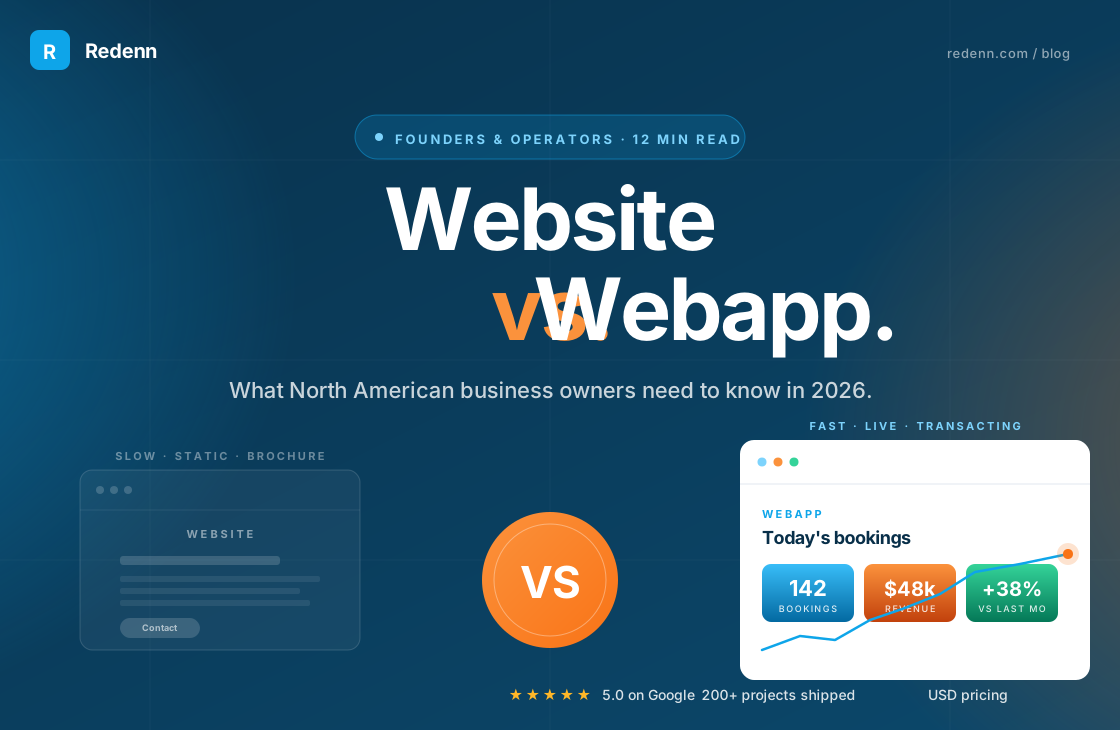
A website is a brochure on the internet. It tells visitors who you are, what you do, and how to reach you. The visitor reads it. That's the whole transaction.
A webapp is a business operating on the internet. It still tells visitors who you are — but it also takes bookings, runs payments, manages a customer portal, sends automated follow-ups, integrates with your accounting tool, and gives you a dashboard to control all of it. The visitor interacts with it. So do you. So does your team.
Same idea as the difference between a printed catalogue and a self-checkout kiosk. Both communicate. Only one transacts.
WEBSITE
A digital brochure
Visitor → reads One-way conversation
WEBAPP
A business engine
Visitor ↔ interacts Two-way, in real time
Ten differences that show up in your bottom line
Below are the places business owners feel the difference most acutely — the things you'll notice in your invoices, your customer reviews, and your weekly P&L.
| Category | Traditional website | Modern webapp |
|---|---|---|
| 1Purpose | A digital brochure that tells visitors about you. | A business engine that tells, transacts, and reports back. |
| 2Speed | 4–8 seconds load on mobile is common, often worse with plugins. | Sub-second loads on first visit, near-instant on every page after. |
| 3SEO foundation | SEO bolted on later through plugins; structure works against you. | SEO built into the architecture — schema, sitemaps, fast pages from day one. |
| 4Customer interaction | A contact form that emails you. That's the entire interaction. | Bookings, accounts, quotes, payments, document approvals — handled live. |
| 5Scalability | Adding a new feature usually means a rebuild or a third-party tool bolted on. | New features ship as updates onto the same foundation. The platform grows with you. |
| 6Mobile experience | "Responsive" — meaning the desktop layout is squashed onto a phone. | Designed mobile-first. Feels like a native app even though it lives in the browser. |
| 7Updating content | Call the agency. Wait three days. Pay an hourly fee for a typo fix. | Self-serve admin panel. You change prices, hours, photos, posts in seconds. |
| 8Customer data | Whatever Google Analytics shows you. Mostly bounce rates and page views. | Real customer records — who booked, who paid, who came back, who didn't. |
| 9Tool sprawl | A booking tool, a quoting tool, an invoicing tool, an email tool — five subscriptions. | Most of those handled inside one platform you already own. Cancel the rest. |
| 10Long-term cost | Rebuild every two to three years as the platform ages. Each rebuild starts from zero. | One foundation that you keep adding to. Five-year cost is typically 30–50% lower. |
| 11Security | Held together by plugin patches; one missed update can take the site down. | Modern authentication, encrypted data, automatic security updates — by default. |
What you see vs. what actually matters
Here's the honest reason most websites fail their owners. Business owners — sensibly — look at the design when they evaluate a build. The colours, the photos, the layout, the logo placement. That's the part you can see.
But the design is roughly 10% of what determines whether a site brings you customers. The other 90% lives under the waterline, where you can't see it — and most agencies cut corners precisely because clients can't see it.
"A beautiful design doesn't bring customers on its own. The engine running underneath does. The mistake most owners make is paying for the paint job and assuming the engine came with it."
"I don't have a website yet — should I just build a webapp?"
Short answer: yes. And here's why it's almost never worth starting with a basic website in 2026.
Five years ago, the case for a starter website was budget — a webapp was meaningfully more expensive to build, so a small business would start with a brochure site and "upgrade later." That gap has closed. Modern frameworks, component libraries, and the right development team have brought webapp build costs into the same range as a high-end traditional website. The cost difference today is closer to 20% than the 200% it used to be.
What hasn't changed is the cost of doing it twice. If you build a website now and discover in eighteen months that you need bookings, a portal, real SEO, or any kind of automation, you don't get to upgrade — you rebuild. From scratch. For more than the original site cost. With a fresh round of agency invoices.
Skipping the website tier and going straight to a foundation that can grow is almost always the cheaper path on a five-year view. You spend a little more in year one, and a lot less for the next four.
"I already have a website — should I switch?"
It depends on three honest questions. Pull your site up on your phone right now while you read these.
- Does it load in under three seconds on a 4G connection? If no, you are losing roughly 32% of your potential customers before they ever see your headline.
- Do customers transact with your business through it? If they're sending emails through a contact form and you're then juggling five tools to fulfill them, you're paying for the friction in time and missed conversions.
- Can you change a price, photo, or hour without calling someone? If no, your site isn't yours — it's the agency's. They own your business's most important asset.
If two of those answers are uncomfortable, switching pays for itself within twelve to eighteen months. If all three are uncomfortable, switching pays for itself faster than that — and the longer you wait, the more compounding revenue you leave on the table.
The speed problem, in numbers
This is the chart that should be on every business owner's wall. It's drawn from Google's published research on mobile site behaviour, and it's one of the most consistent findings in the entire field of e-commerce. The y-axis is the share of your potential customers who give up and leave.
Here's the part most people miss: the cost of slow doesn't just show up as bounce rate. It compounds backwards into your Google ranking. Google penalises slow sites in search results, which means slow sites get less traffic, which means the bounce rate is calculated on smaller and smaller numbers, masking how bad the leak actually is. Speed isn't a vanity metric — it's the single highest-leverage variable you have.
What this looks like in practice
Three anonymised examples from clients who switched in the last eighteen months. Different industries, different scales, same arc.
⊕ Dental practice · Toronto
From a 7.4-second WordPress site to a sub-second patient portal
New patient inquiries had dropped 40% year-on-year. We rebuilt as a webapp with built-in online booking, automated SMS reminders, and a portal where patients could fill intake forms before they arrived. The receptionist's phone stopped ringing all morning, and started ringing for the right reasons.
⌂ Contractor · Calgary
Replaced four SaaS subscriptions with one webapp
The owner was paying $400 a month across separate tools for quoting, invoicing, scheduling, and customer follow-up — none of which spoke to each other. We built a custom webapp wrapped around a public marketing site that handled all four flows in one dashboard. The build paid for itself in 14 months from cancelled subscriptions alone.
◈ Restaurant group · Vancouver
Five sites, five managers, one platform
The group had five separate marketing sites for five locations, all on a different agency retainer of $1,800 a month. Local managers couldn't update their own page without escalating. We shipped one webapp where each manager has a portal to update menu items, hours, and specials in real time. The retainer went to zero, and the locations finally felt up-to-date instead of three months behind.
Why Redenn
Most agencies sell you the design. We ship the engine too.
Here's something the industry doesn't talk about often, but should: the agency you hire in Toronto, New York, or London is almost certainly outsourcing the actual development to teams in India, Pakistan, Bangladesh, or the Philippines. That's an open secret, and it's not the problem on its own — global teams build excellent work every day. The problem is what comes back.
Most outsourced builds deliver what the client signed off on — the design — and quietly cut corners on the engineering underneath, because that's the part the client never inspects. You receive a homepage that looks beautiful in the demo, loads in eight seconds in production, breaks the first time traffic spikes, and needs a full rebuild within two years.
We do it differently. Most of our engineering team is in Patiala, India. Our design and client management is in Brampton, Ontario. One studio, two offices, no agency-of-an-agency markup. We charge fair North American rates without the New York surcharge — but more importantly, we don't separate the design from the engineering. They ship together, by the same team, with the same standards. Both ship right.
Every webapp we deliver comes with the SEO foundation pre-built — schema markup, sitemap generation, page-speed budgets, semantic HTML, accessibility standards. None of that is an upsell. It's table stakes for us, because shipping a fast, indexable, scalable webapp is just our default. The thing other agencies charge extra for is the thing we won't ship without.
The era of speed
Five years ago, a five-second load time was acceptable because most of your competitors were just as slow. That's no longer true. The web has moved on, customers have moved on, and the businesses that haven't are quietly losing share to the ones that did.
Your website is meant to work at the speed of light. If it doesn't, the customer goes to whoever's does. That's not a design problem you can solve with a new colour palette. It's an engineering decision you make once, and benefit from for years.
If you're starting fresh, build the foundation that grows with you. If you've already got a website that's costing you customers without telling you it is, the switch is cheaper, faster, and more boring than you think — and on a five-year view, it's almost always the better economic decision.
Either way, we'd be glad to take a look at what you have today and tell you honestly whether you need to switch. No obligation, no hard sell — most of the businesses we audit don't end up working with us, and we're fine with that. We just don't like watching good businesses leak customers to a problem they didn't know they had.
Want this done properly on your site?
Tell us the goal in a sentence. A senior person replies within 4 business hours.
Keep reading
September 9, 2026
Why Most Small-Business Websites Lose Customers Before the First Click
Most small-business websites fail quietly. Here's why customers leave and what Redenn Informatics does differently to fix it.
September 8, 2026
Choosing a Web Development Partner: The Questions That Actually Matter
Before hiring a web developer, ask about ownership, process, and what happens after launch. A practical guide from Redenn Informatics.
September 7, 2026
Accessibility as a Business Advantage: Compliance Isn't the Point, Revenue Is
Accessibility isn't a legal checkbox. It's a growth lever most competitors ignore. Here's how Redenn Informatics builds for it properly.
Got a project in mind?
We will send back a fixed price and a ship date — no discovery deck, no hourly rates, within two business days.
We reply within 4 business hours.