

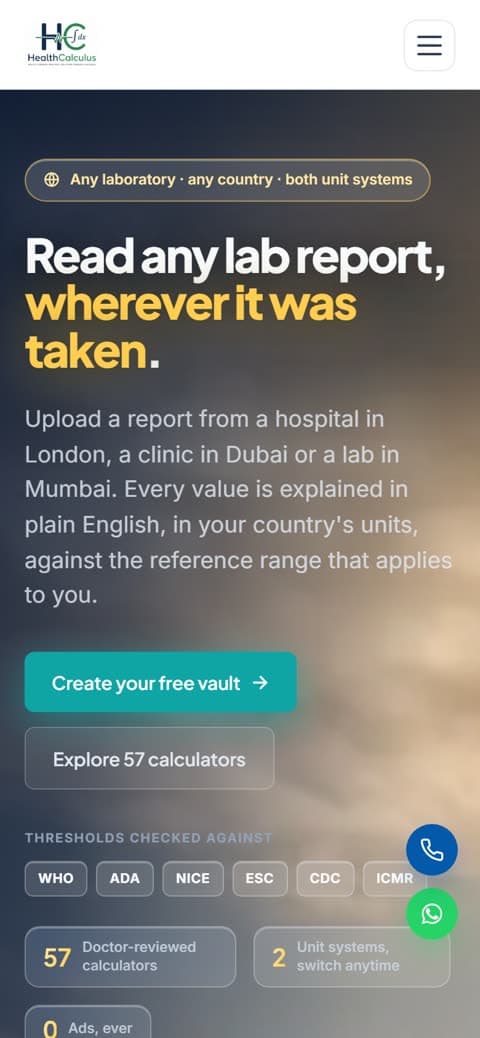

HealthCalculus
A family health portal that reads lab reports in plain language
Get time back · Software and integrations
Software built around how your team already works, with the permissions and connections it needs.
Custom software built around your process: internal tools, operations systems, multi-tenant SaaS, and migration off spreadsheets and legacy tools.
Every business that outgrows its tools outgrows them the same way. One spreadsheet becomes four. Someone adds a macro. A fifth spreadsheet exists only to reconcile the other four. Pricing rules live in one person's head, and the monthly report takes a day because three systems disagree about the same number. Nothing looks broken. The business has simply started doing work the software should be doing.
Off-the-shelf products solve this well for the companies they were designed around. For everyone else it means bending your process to fit someone else's assumptions, paying per seat for modules nobody opens, and keeping the spreadsheet anyway. Custom software is the other option: a system shaped to how you actually work, that you own outright.
We start with the process, not a feature list. Discovery means watching the work happen: who touches a job, in what order, where it stalls, which exceptions everyone quietly handles by hand. That map becomes a written technical specification you sign off before a line of code exists. Most failed software projects were mis-specified, not mis-built.
We scope a first version that earns its keep. The fastest way to waste a budget is to build eighteen months of features before anyone uses one. We identify the smallest system that removes real work, ship it, and let daily use decide what comes next.
We build for the developer who comes after us. Typed code, a documented data model, tests on the logic that would hurt most if it broke, and a handover covering the repository, environment variables, deploy keys and admin docs. You should be able to hire anyone to extend it. We would rather be kept than needed.
Next.js 16, React and TypeScript on the front end; Postgres with Drizzle as the data layer; Supabase authentication with row-level security; Vercel hosting with preview deploys and instant rollbacks; Resend for transactional email; Stripe or Razorpay where money moves. Multi-tenant SaaS products get tenant isolation enforced in the database, per-tenant configuration, and subscription billing wired in from the start.
Internal software holds the same standards as our public sites: fast on a real phone (we measure it before launch), WCAG 2.1 AA as our accessibility target, mobile-first, because operations tools get used on phones in vans and on shop floors far more than anyone plans for. Client leadership sits in Brampton, engineering in Patiala. The CRM and the AI chatbot behind redenn.com are our own builds on this stack, in daily production use.
An internal operations system replacing a spreadsheet stack. A company tracking jobs, inventory or client work across spreadsheets, email and a half-used SaaS tool gets one system: records, statuses, assignments, documents and reporting in one place, with the reconciliation step deleted rather than automated. It starts narrow and grows module by module once the team lives in it. Where it has to reach accounting, payments or shipping, that runs alongside as API and systems integration.
A multi-tenant SaaS product. A founder, or an established business productising something it already does well, needs signup, tenant isolation, roles, billing, an admin console and a support path: the unglamorous surface underneath the idea. Built properly, the roadmap after launch is features rather than repairs. Close cousin to our webapps and CRM development work.
Custom software is scoped per project. A three-person team replacing two spreadsheets and a forty-seat business rebuilding its operating system need very different systems, and one price list would mislead both. You get a 30-minute call, a written scope, then a fixed price against it. Contact us for a quote.
A family health portal that reads lab reports in plain language

An immigration platform we built and run ourselves
We also build and run four platforms for our own group, Pro Lifeset: SureshotVisa, Lifeset Overseas, CAIPS Notes Apply, SureshotTravel.
Share current tools, sample records and the decisions that require human judgment. Highlight reporting, access and audit requirements before they become late additions.
Review whether users can complete the intended work reliably. Delivery should include a way to operate, support and extend the system after launch.
A few lines on the form, or ask the assistant. A person replies within 4 business hours.
What to fix first and why, what we'd build and run, the price and the go-live date, in writing within two business days.
A website takes 2 to 6 weeks, a web app 8 to 16. Tested on real phones before launch.
Hosting, updates and the systems kept working. Monthly plans cancel any time.
You own everything.
Your code, your domain, your accounts and your data.
One contract, your currency.
You sign with Redenn Informatics Pvt. Ltd. (India) and are invoiced in your own currency. North American work is led from our Brampton, Ontario office (Redenn Informatics Inc.).
Tested on real phones.
Built mobile-first, load time measured before launch, designed to WCAG 2.1 AA.
Prices published.
Websites from $1,200, web apps from $15,000, monthly systems $149 to $249/mo plus setup from $500, and care from $49/mo.
Quoted and invoiced in your own currency by Redenn Informatics Pvt. Ltd. (India); pay by card through Razorpay or by bank transfer.
Custom software is scoped per project because the range is genuinely wide — a focused internal tool is a different job from a multi-tenant SaaS product. The price is driven by the number of screens and user roles, the integrations required, how messy the data being migrated is, and the reporting you need. Before any build starts you get a written specification — data model, user roles, screen-by-screen scope, integrations, and an explicit out-of-scope list — with one fixed price attached, and you sign off before a line of code exists. That out-of-scope list matters as much as the number: it is what prevents the surprise invoices custom software is notorious for.
If spreadsheets still work, keep using them — they are free and everyone understands them. The tipping point usually arrives when several people edit the same sheet, when nobody quite trusts the numbers anymore, or when a critical process lives in one person's head and one fragile file. Custom software earns its cost by adding what spreadsheets cannot: role-based permissions so people see only what they should, audit trails and record history so you know who changed what and when, and dashboards that update themselves. On the scoping call we will tell you honestly if an off-the-shelf tool would do the job.
You own the codebase outright, and handover is a listed deliverable, not a favour: training, admin documentation, and full transfer of every account. The stack is deliberately mainstream — Next.js, React and TypeScript on the front end, Postgres for data, Supabase for authentication, Vercel for hosting — so a large pool of developers worldwide could maintain it if you ever chose to move on. Nothing is built on a proprietary framework only we understand. A post-launch support window is included, and an optional Care Plan covers the long term, but the Care Plan carries no lock-in — it is a choice, not a hostage situation.
A person replies within 4 business hours. Your written growth plan follows within two business days.
Or call +1 437 524 3001 or toll-free +1 888 905 4003, or email hello@redenn.com.