

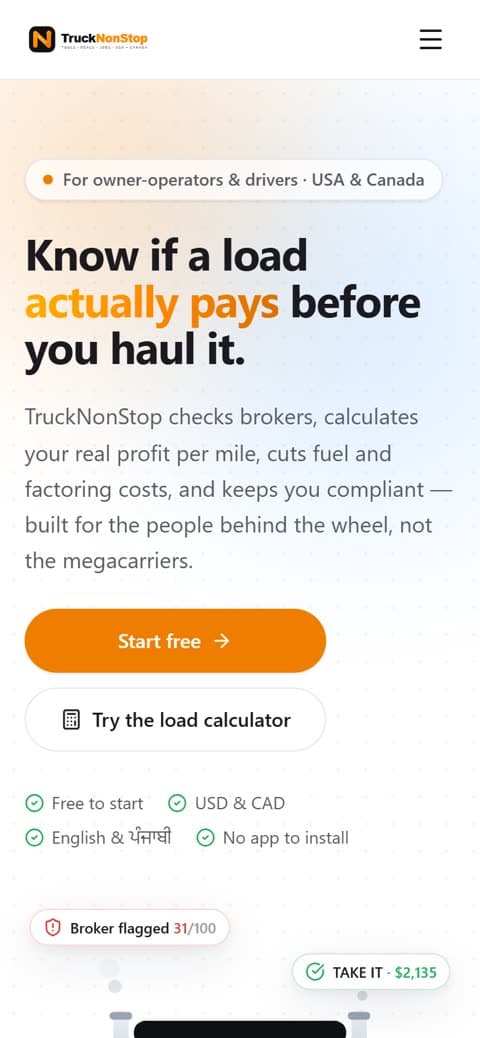

TruckNonStop
Tools that tell owner-operators whether a load actually pays
Get time back · AI that does the work
Find where AI saves your team real time, and where it won't, before you spend on a build.
Your clinic, after hours
AI assistant · 10:42 PM
AI consulting from people who ship AI features: opportunity audit, build-vs-buy analysis, data readiness, and honest roadmaps — even when the answer is no AI.
Too much AI consulting has a product problem: the product is the deck. A strategist interviews your team for two weeks, delivers sixty slides about "transformation," and is gone before anyone has to make a single thing work. Six months later the slides are in a drawer and the only AI in the building is whatever your staff quietly paste into a free chatbot.
We come at this from the other side. We're an engineering shop that ships AI features — retrieval-backed assistants, lead-qualification flows, content pipelines — inside the same Next.js stack we build our custom websites and webapps on. When we advise on AI, the advice is shaped by what survives contact with production: latency, hallucination rates, token costs at real volume, and the unglamorous state of most companies' data.
The audit starts with your workflows, not the technology. We map where hours actually go and where errors actually happen — intake, quoting, support, reporting — and only then ask which of those a model can genuinely absorb. Use cases get ranked by payback and risk, not by demo appeal.
"You don't need AI for this" is a real deliverable. A meaningful share of what gets pitched as AI is a cron job, a validation rule, or a SaaS setting nobody turned on. When the honest answer is boring automation, the roadmap says so, with the cost difference in writing. We'd rather lose a build than sell you one you don't need.
Model-agnostic. The build-vs-buy analysis compares like with like: what the vendor charges at your projected volume, what a build costs to run and maintain, and where the crossover sits. If one of our own Redenn Systems is a candidate, it is priced in the same table as the alternatives.
We're model-agnostic across Claude, GPT, Gemini, and open-weight options. Four criteria, in order: accuracy on your task (measured with a small eval set built from your real examples, not vendor benchmarks), latency, cost at production volume, and privacy / data-residency fit. For prototypes we reach for the Vercel AI SDK, retrieval on Postgres + pgvector, and evals before demos — if a recommendation can't survive a fifty-example eval, it doesn't go in the roadmap. And if the roadmap ends in a build, we can be the ones who build it — or hand the spec to your team.
Two typical engagement shapes:
The opportunity audit. A service business drowning in repetitive inbox, intake, or quoting work wants to know what AI can actually take off its plate. We interview the team, map the workflows, and deliver a ranked roadmap. Sometimes the top item is an LLM-backed intake assistant; sometimes it's plain automation with no model in it. Either way you get the reasoning and the numbers, and a plan you can execute with us or with anyone else.
The feasibility spike. A company already sold on a specific idea — or being pitched hard by a vendor — wants proof before committing. We build a thin working prototype against a sample of your real data, run an eval, model the cost at production volume, and deliver a build-vs-buy memo. It's the cheap way to avoid an expensive mistake in either direction.
AI consulting is scoped to the project. An opportunity audit for a five-person firm and a feasibility spike for a two-hundred-seat rollout are different animals, and pretending one price list covers both is how slide-deck consulting happens. Tell us what you're weighing and we'll come back with a fixed-price scope — contact us for a quote.
Tools that tell owner-operators whether a load actually pays
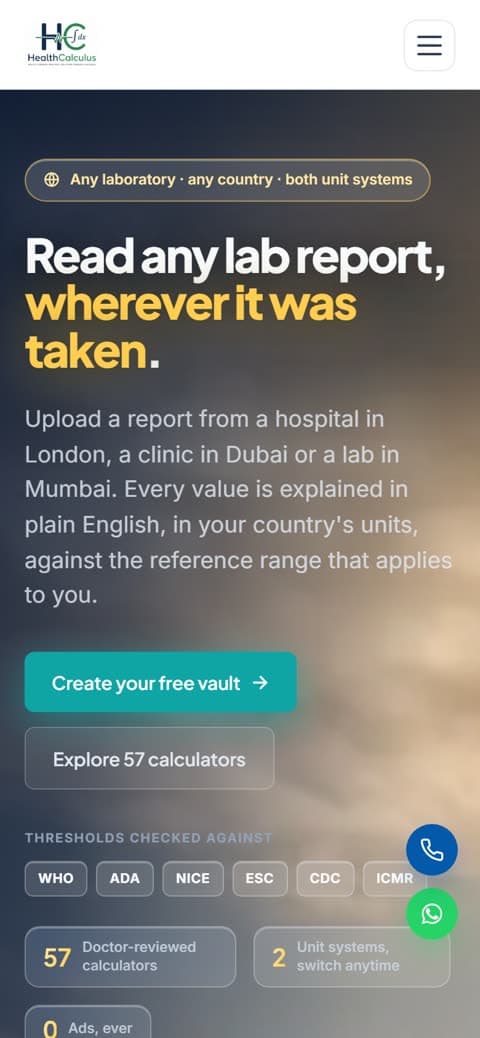
A family health portal that reads lab reports in plain language
We also build and run four platforms for our own group, Pro Lifeset: SureshotVisa, Lifeset Overseas, CAIPS Notes Apply, SureshotTravel.
Bring the workflows that consume time, the tools involved and a person who does the work. Start with the business problem rather than a preferred AI model.
The useful output is a decision and a prioritized next step. If an ordinary integration or an existing product is sufficient, a custom AI build may not be the right investment.
A few lines on the form, or ask the assistant. A person replies within 4 business hours.
What to fix first and why, what we'd build and run, the price and the go-live date, in writing within two business days.
A website takes 2 to 6 weeks, a web app 8 to 16. Tested on real phones before launch.
Hosting, updates and the systems kept working. Monthly plans cancel any time.
You own everything.
Your code, your domain, your accounts and your data.
One contract, your currency.
You sign with Redenn Informatics Pvt. Ltd. (India) and are invoiced in your own currency. North American work is led from our Brampton, Ontario office (Redenn Informatics Inc.).
Tested on real phones.
Built mobile-first, load time measured before launch, designed to WCAG 2.1 AA.
Prices published.
Websites from $1,200, web apps from $15,000, monthly systems $149 to $249/mo plus setup from $500, and care from $49/mo.
Quoted and invoiced in your own currency by Redenn Informatics Pvt. Ltd. (India); pay by card through Razorpay or by bank transfer.
Five concrete things. A ranked shortlist of AI use cases in your business, built from structured interviews and mapping how work actually flows through your team. A feasibility and build-versus-buy analysis for the top candidates, with real cost modelling instead of optimistic guesses. A data-readiness assessment showing where your data lives, how clean it is, and what needs fixing first. A sequenced, budgeted roadmap with explicit kill criteria, so you know in advance what result would justify stopping. And working sessions with your team covering prompt patterns, guardrails and a clear policy on what never gets pasted into a chatbot, so the knowledge stays in your building.
Then that is the answer you get, in writing, with the reasons. Every roadmap we produce includes kill criteria, meaning the specific conditions under which an idea should be dropped, because the most expensive AI project is the one that should never have started. Sometimes the finding is that your data is not ready, or that an off-the-shelf tool beats a custom build; the build-versus-buy analysis exists precisely to say so, with the cost difference in writing. This consulting is done by people who build AI systems for a living, so we have no incentive to recommend work that would not survive production.
The two common shapes have published ranges: an AI opportunity audit runs 2 to 3 weeks, and a feasibility spike, where we build a working prototype against sample real data and model costs at production volume before you fund a full build, runs 3 to 5 weeks. Both are deliberately short, because the point of consulting is to reach a confident decision quickly, not to stretch into an open-ended retainer. If the audit says build, you leave with a sequenced and budgeted roadmap. If it says wait, you have spent weeks finding that out instead of months and the price of a failed project.
A person replies within 4 business hours. Your written growth plan follows within two business days.
Or call +1 437 524 3001 or toll-free +1 888 905 4003, or email hello@redenn.com.