

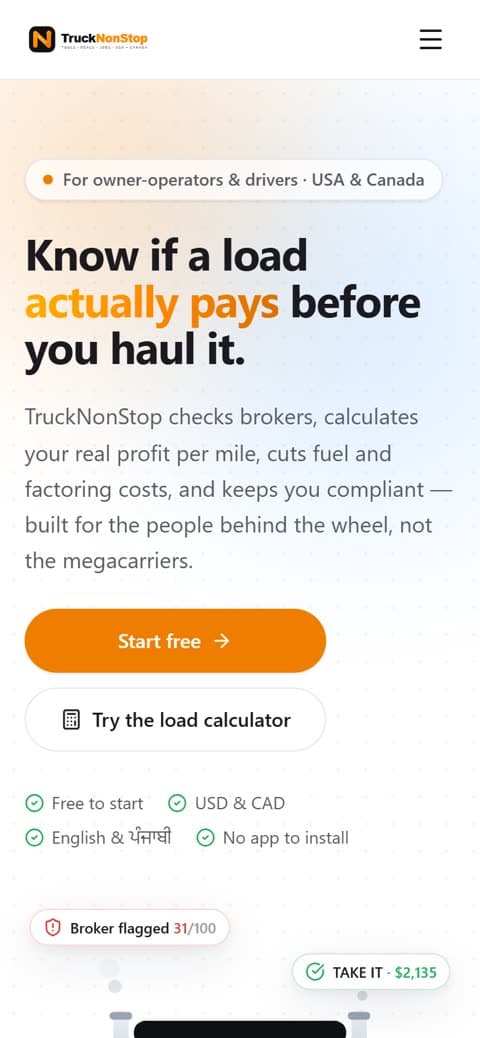

TruckNonStop
Tools that tell owner-operators whether a load actually pays
Get time back · AI that does the work
Scoring, forecasting and recommendations, tested against your own data before anyone relies on them.
Your clinic, after hours
AI assistant · 10:42 PM
Machine learning that ships: lead scoring, churn, forecasting, recommendations — deployed as APIs inside your webapp, with drift monitoring built in.
"Machine learning" arrives at most businesses in one of two costumes: a research project that produces a beautiful notebook and no production code, or an enterprise platform priced for enterprise budgets. Both miss where the value actually sits. The data already in your CRM, your order history, and your analytics knows things — which leads will close, which customers are about to leave, what next month's demand looks like. It needs a model on top and a way to put the answer in front of the person making the decision.
That last part is where we're different. We're a web engineering firm that builds ML, not an ML lab that tolerates web work.
Models ship as product features, not deliverables. The end state of every engagement is a versioned API running inside your webapp — a score next to each lead in your dashboard, a forecast on the purchasing screen, a "customers also bought" rail on the product page. If the prediction never reaches a screen someone acts on, the model didn't ship.
Boring models first. For tabular business data, gradient boosting and regularised regression beat deep learning most of the time — and they're explainable, cheap to run, and easy to retrain. We reach for PyTorch when the problem genuinely needs it (text, images, sequences), not to decorate a proposal.
Monitoring is part of the build, not an upsell. Every deployed model ships with drift monitoring: input distributions, prediction distributions, and accuracy tracked against ground truth as it arrives. A model that silently degrades is worse than no model, because you stop questioning numbers that look official.
Everything integrates naturally with the webapps we build — see /services/webapps — but we also deploy into existing stacks.
Two typical engagement shapes:
Lead scoring for a service business. Your CRM holds a few years of inquiries — some closed, most didn't. We train a scoring model on that history and wire it into the inbound flow: every new lead lands with a score and the three factors driving it, so your team calls the likeliest closers first. Usually paired with a small CRM cleanup, because label quality decides model quality.
Demand forecasting for an ecommerce operation. Order history, seasonality, and promotions feed a weekly per-category forecast that appears on the purchasing screen next to current stock. The goal is fewer stockouts and less cash frozen in slow inventory — a natural companion to an ecommerce build.
Other common shapes: churn early-warning for subscription businesses, anomaly detection on transactions or operational metrics, and recommendation rails for catalogs large enough to need them.
Machine learning work is scoped to the project. An honest quote depends on your data, the decision the model feeds, and where it needs to deploy — so we quote after a short conversation, not from a tier table. Contact us with a paragraph on what you're trying to predict and what data you have. Within two business days we'll tell you whether it's feasible, what shape the engagement takes, and — when ML isn't the right tool — that a simpler rules-based approach will serve you better.
Tools that tell owner-operators whether a load actually pays
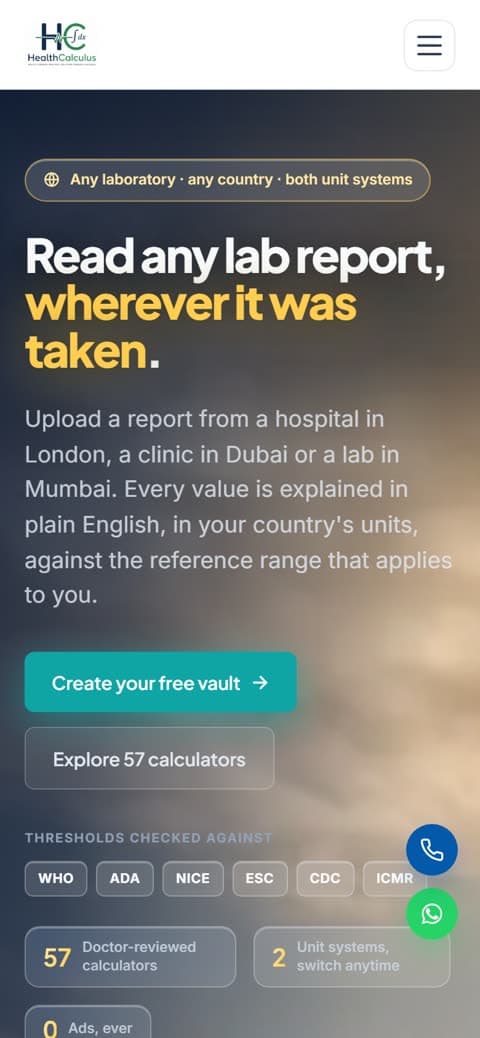
A family health portal that reads lab reports in plain language
We also build and run four platforms for our own group, Pro Lifeset: SureshotVisa, Lifeset Overseas, CAIPS Notes Apply, SureshotTravel.
Bring representative historical data, definitions for the target outcome and known gaps. A useful feasibility review may conclude that a simpler rule or better data collection is the right first step.
Evaluate on data the model has not trained on and connect performance to business consequences. An impressive average can hide costly errors in important cases.
A few lines on the form, or ask the assistant. A person replies within 4 business hours.
What to fix first and why, what we'd build and run, the price and the go-live date, in writing within two business days.
A website takes 2 to 6 weeks, a web app 8 to 16. Tested on real phones before launch.
Hosting, updates and the systems kept working. Monthly plans cancel any time.
You own everything.
Your code, your domain, your accounts and your data.
One contract, your currency.
You sign with Redenn Informatics Pvt. Ltd. (India) and are invoiced in your own currency. North American work is led from our Brampton, Ontario office (Redenn Informatics Inc.).
Tested on real phones.
Built mobile-first, load time measured before launch, designed to WCAG 2.1 AA.
Prices published.
Websites from $1,200, web apps from $15,000, monthly systems $149 to $249/mo plus setup from $500, and care from $49/mo.
Quoted and invoiced in your own currency by Redenn Informatics Pvt. Ltd. (India); pay by card through Razorpay or by bank transfer.
Each project is priced individually with one fixed quote, and the number tracks three things: the state of your data, the decision you're trying to predict, and where the model has to deploy. Predicting churn from a clean subscription database is a smaller engagement than demand forecasting that has to join messy sales, inventory and seasonal data. The structure protects you either way — a data audit and feasibility read comes first, so you learn whether your data can support the model before serious money is spent on modelling, and because the scope is agreed up front, the price you sign off on is the price you pay.
That's the first question every engagement answers, not the last. It starts with a data audit and feasibility read: we look at what you actually have — CRM records, transactions, order history — and tell you whether it can support the prediction you want. If the data can't support the model, we say so in week one, not month three, and the honest next step is usually collecting better data before building anything, rather than forcing a model onto thin evidence. Every model we do build is trained against a naive baseline, so if machine learning can't beat a simple rule of thumb on your data, you'll know that too.
The patterns we build most are practical ones: lead scoring that ranks inquiries by how likely they are to convert, so your team calls the right people first; churn prediction that flags customers showing exit behaviour while there's still time to act; demand forecasting to inform what you stock and when; anomaly detection that catches odd transactions or operational spikes; and recommendation rails for product catalogues. In every case the output ships as a product feature inside your webapp — admin dashboard views showing the scores, the confidence, and the drivers behind each prediction — not as a slide deck or a notebook someone has to rerun.
A person replies within 4 business hours. Your written growth plan follows within two business days.
Or call +1 437 524 3001 or toll-free +1 888 905 4003, or email hello@redenn.com.